
Fingerprint and Handwriting Engraving: Making a Piece Personal
A fingerprint ring or a piece engraved with real handwriting turns a print or signature into metal. How it is captured, cut, and how it wears over time.
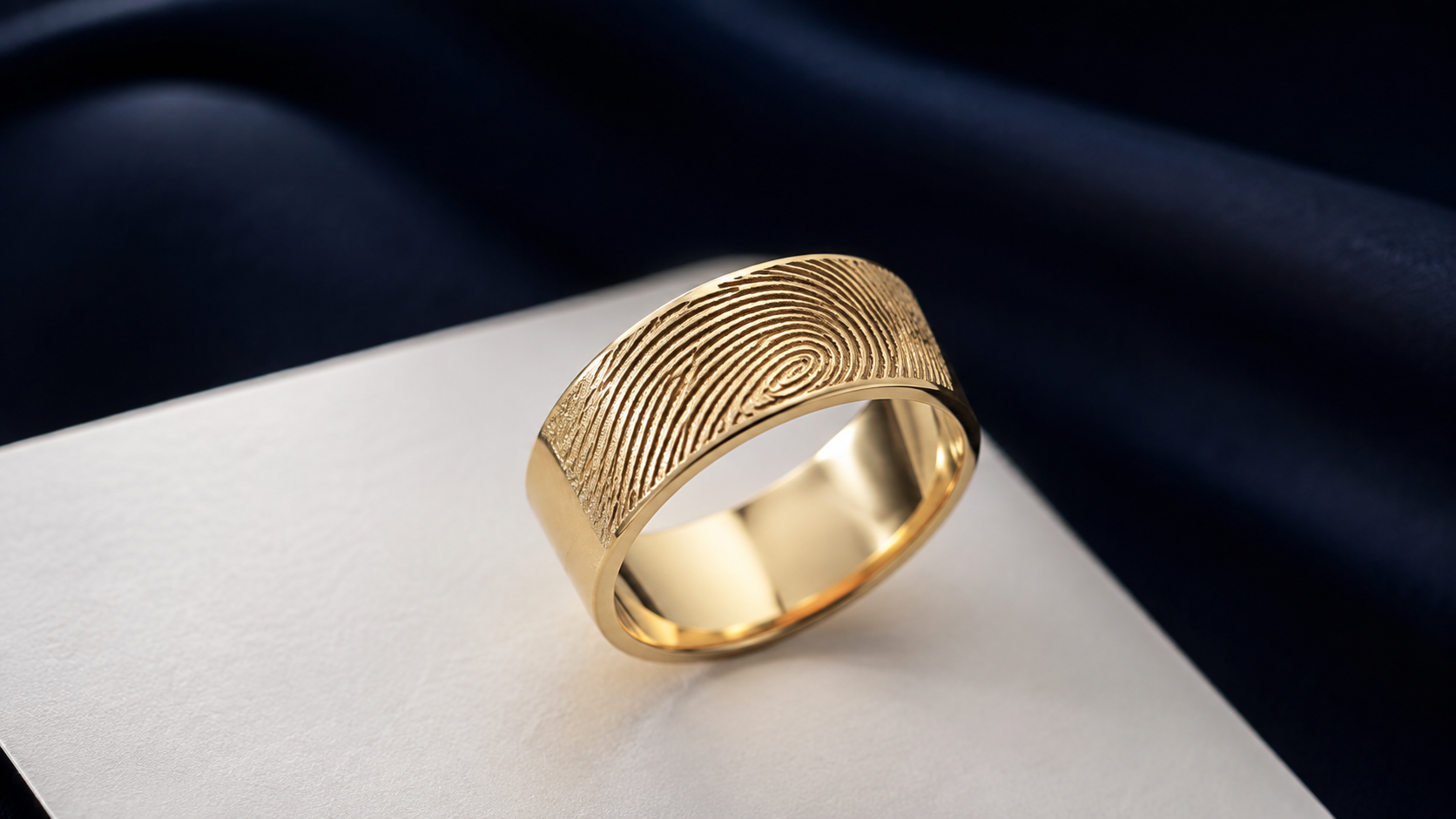
There is a category of engraving that has nothing to do with fonts. A fingerprint ring carries the actual ridges of one person's finger. A handwriting piece carries the exact strokes of a note or a signature. These are not decorations chosen from a catalogue; they are records of a specific person, and the methods for making them well are worth understanding before commissioning one.
Capturing a fingerprint
Ink on paper. The oldest method and still reliable. A clean, even print on smooth card, scanned at high resolution. Smudges and pressure marks transfer directly to the metal, so several prints are taken and the cleanest chosen.
Digital scan. A flatbed scanner or a phone camera with good light can capture a print directly from the finger. Quality varies with the device. A dedicated scan is better than a photograph.
Impression. A print pressed into a soft wax or silicone pad, which is then scanned or photographed with raking light. This gives depth information and is the method used when the print will be reproduced as a raised or recessed relief rather than a line engraving.
From documents. For memorial pieces, a print may come from a hospital record, an inked card or an identity document. Resolution is often low, and the workshop will need to clean the image without inventing detail.
How it is cut
A fingerprint is a pattern of fine ridges, and it is almost always laser engraved. The scanned image is traced, cleaned and scaled to the surface, then cut. Two outcomes are possible.
Surface engraving. The ridges are marked into the metal as fine dark lines. Clean and detailed, and the usual choice for the outside of a band or the face of a pendant.
Relief. The ridges are cut away or left standing so the print can be felt with a fingertip. Deeper, more tactile, and better at surviving polishing. This suits a wide band, a signet or a disc pendant.
A fingerprint on the inside of a ring is possible but rarely worth it. The inside surface is small, curved and constantly worn, and the fine lines soften quickly.
Handwriting and signatures
A line of writing is captured from the original paper: a letter, a card, a signature on a document. The workshop scans it, traces the strokes and removes paper texture and stray marks. What is preserved is the pressure, the slant and the odd loop that makes it recognisably one person's hand.
Handwriting suits a bar pendant, a disc, a cuff or the outside of a wide band. Inside a narrow ring, the strokes must be reduced so far that the character of the writing is lost, and a plain font would honour the words better.
Ask to see the traced artwork before cutting. A good tracing preserves the hesitation and thickness of the original. A poor one turns it into a generic script.
What to expect over time
Laser marks are shallow by nature. On the outside of a ring, the ridges of a fingerprint will soften with years of contact and polish. That is not a fault, and many clients like the way the print becomes part of the metal. If permanence matters, choose relief engraving on a broad surface, a pendant that is not rubbed, or a heavier gold that polishes less often.
Rhodium-plated white gold will need replating from time to time, and each polish before plating takes a little of the engraving. Yellow or rose gold, or platinum, hold a fingerprint better over decades.
Uses we see most
Wedding bands carrying each partner's print on the other's ring.
A parent's ring with a child's print, taken when the child is young enough for it to be a record of that age.
Memorial pieces with the print of someone who has died, often set with a small stone inside.
A signature pendant made from a handwritten line in a letter.
Getting it right
Take the print or scan the handwriting before the design is finalised, not after. Choose a surface large enough for the detail. Ask for the artwork proof and look at it under magnification. And decide, honestly, whether you want the mark to be permanent or to age with the piece, because that decides the method.
Book a complimentary design consultation at the C'Garden atelier, The MET Corporate Towers, Kuala Lumpur: 010-766 7448 · hq@cgarden.com.my
C'Garden is an independent bespoke jeweller in Kuala Lumpur. We are not affiliated with, endorsed by, sponsored by or certified by any organisation, laboratory or brand named in this article. Third-party names are used only to refer factually to those organisations and their published standards. All text and imagery in this article is original work created by C'Garden.
Reference
Jewelers of America. (n.d.). Buying jewelry. Jewelers of America. https://www.jewelers.org/buying-jewelry
All journal entries