
Fancy Colour Diamonds: How Colour Changes Everything
Fancy colour diamonds are graded on a different scale, cut and valued on different terms from white stones. How hue, tone and saturation replace D to Z.
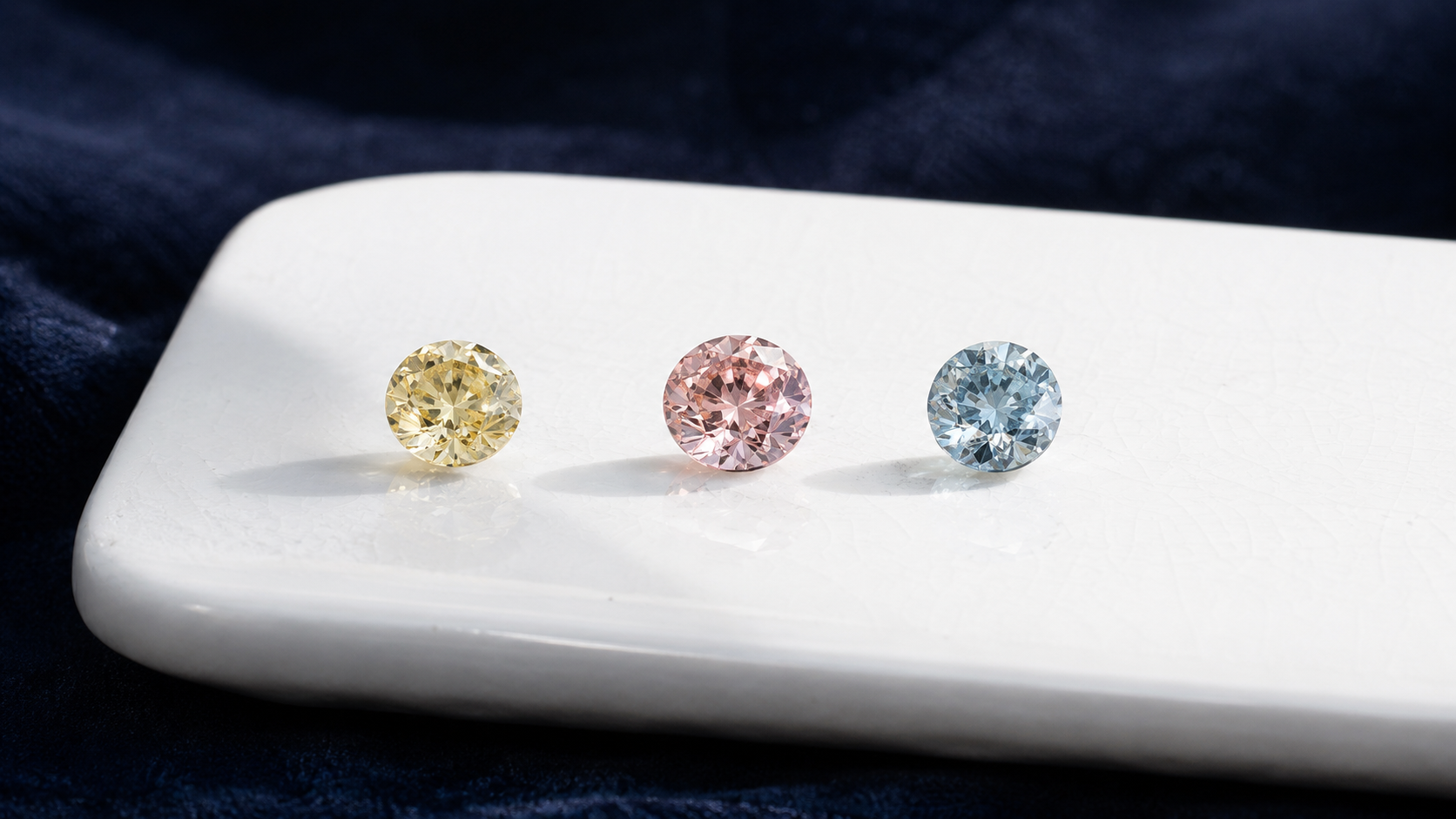
For a white diamond, colour is a flaw to be minimised. For fancy colour diamonds, colour is the entire point, and everything about how the stone is graded, cut and priced turns upside down. A buyer who approaches a yellow or pink diamond with the rules of the D to Z scale in mind will get most of the decisions wrong.
Where the scale ends and the fancy grades begin
The D to Z scale measures the absence of colour. A Z stone has a light yellow or brown tint. Beyond Z, the colour is strong enough that the stone is graded by its colour rather than against it, and it enters the fancy range.
Yellow and brown diamonds have to pass Z to be called fancy. Any other colour, pink, blue, green, orange, purple, red, is graded as a fancy colour from the moment it shows at all, because those hues are rare enough that even a faint trace has value.
How fancy colours are graded
Three properties replace the single letter.
Hue is the colour itself: yellow, pink, blue, and the many mixtures. A stone may be described as orangy yellow, purplish pink, greenish blue. The main hue is the last word; the modifier is the tint pulling it sideways.
Tone is how light or dark the colour is.
Saturation is how strong or weak the colour is, from a faint wash to an intense, pure colour.
Tone and saturation together produce the grade terms most buyers see: Faint, Very Light, Light, Fancy Light, Fancy, Fancy Intense, Fancy Vivid, Fancy Deep and Fancy Dark. Fancy Vivid is the most saturated in the lighter tones and, for most hues, the most valuable. Fancy Deep and Fancy Dark describe strong colour at darker tones.
Grading is done face up, not face down as with white stones, because the face-up colour is what matters and because cutters shape fancy stones specifically to maximise it.
Why the cut is different
A white diamond is cut to return light. A fancy colour diamond is cut to hold light inside the stone long enough to pick up colour. That means deeper pavilions, different facet angles and a preference for shapes that intensify colour: radiants, cushions and ovals rather than round brilliants.
A round brilliant in a fancy colour is unusual and often less saturated than the same rough cut as a radiant. The cutter chooses the shape for the colour, not the other way round.
Clarity matters less
In white diamonds, clarity is a headline grade. In fancy colours, it is secondary. Strong colour hides inclusions, and buyers accept lower clarity grades in exchange for better colour without hesitation. A Fancy Intense yellow with SI clarity is a normal, desirable stone.
Value
Price in fancy colours depends first on hue, then on saturation, then on size. The order of rarity, broadly, runs from yellow and brown at the accessible end, through pink and blue, to green, orange, purple and, rarest of all, red. Within any hue, each step up in saturation roughly multiplies the value rather than adding to it.
Secondary hues change value sharply. A pure pink is worth far more than a brownish pink of the same strength. A pure blue is worth far more than a greyish blue.
Natural, treated and grown
Because colour drives value, colour is what gets manipulated. Irradiation and HPHT can turn ordinary stones green, blue, pink or yellow. Laboratory-grown diamonds are produced in fancy colours easily and cheaply.
None of this is a problem when disclosed. All of it is a problem when it is not. A report from a major laboratory states whether the colour is natural, and for a stone of any value that report is not optional.
A sensible entry point
Fancy yellow is where most people start. Yellow diamonds are the most available fancy colour, they suit yellow gold, and a Fancy Intense yellow in a radiant cut is a beautiful stone at a price that bears comparison with a white diamond of similar size. Pink and blue are different territory and are bought as much for rarity as for beauty.
Whatever the colour, see it in daylight. Fancy colour shifts more with lighting than white ever does, and a stone that glows under a spotlight can look flat by a window.
Book a complimentary design consultation at the C'Garden atelier, The MET Corporate Towers, Kuala Lumpur: 010-766 7448 · hq@cgarden.com.my
C'Garden is an independent bespoke jeweller in Kuala Lumpur. We are not affiliated with, endorsed by, sponsored by or certified by any organisation, laboratory or brand named in this article. Third-party names are used only to refer factually to those organisations and their published standards. All text and imagery in this article is original work created by C'Garden.
Reference
Gemological Institute of America. (n.d.). Colored diamonds. GIA. https://www.gia.edu/colored-diamonds
All journal entries