
Family Rings and Mother's Rings: Designing With Birthstones
A mothers ring birthstones design carries one stone per child. Which stones survive daily wear, how to arrange them and what to do about the soft months.
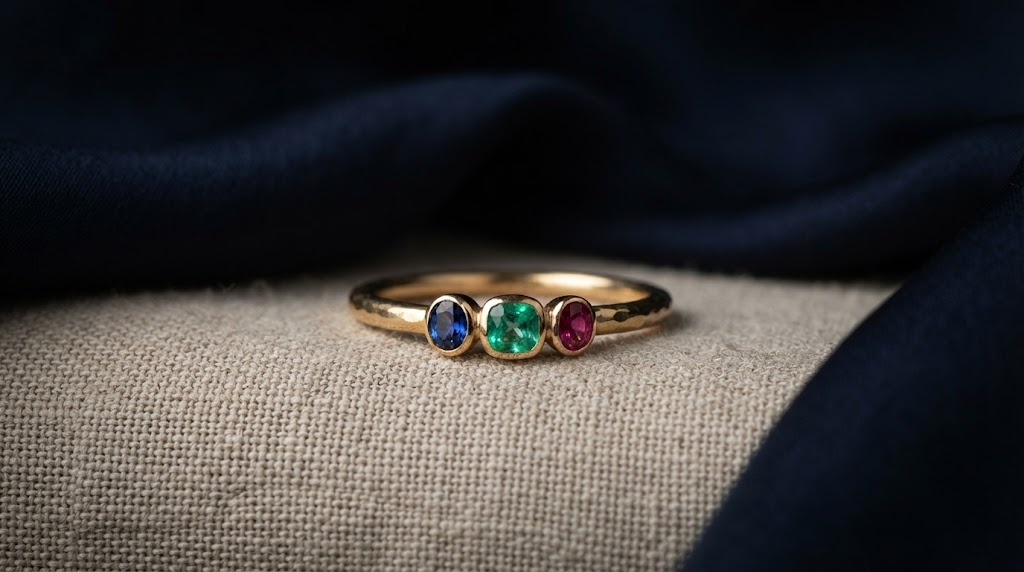
A mothers ring birthstones design is one of the most requested family commissions we make: one stone for each child, sometimes for each grandchild, set into a single band. The idea is simple and the sentiment is strong. The design problem is that birthstones were assigned by tradition rather than durability, and several of them are not suited to a ring worn every day.
Here is how to make one that works.
The modern birthstone list
The list most jewellers use today was standardised in the United States in 1912 and has been amended a few times since. In outline: January garnet, February amethyst, March aquamarine, April diamond, May emerald, June pearl or moonstone or alexandrite, July ruby, August peridot or spinel, September sapphire, October opal or tourmaline, November topaz or citrine, December turquoise or tanzanite or blue zircon.
Several months have alternatives, which is useful, because it gives a way around the fragile stones.
Which stones survive a ring
Hardness on the Mohs scale is the practical measure. Anything at 7 or above resists the scratches of daily life; anything below it will dull.
Robust. Diamond (10), ruby and sapphire (9), spinel (8), topaz (8), aquamarine (7.5 to 8), amethyst and citrine (7), garnet (6.5 to 7.5), tourmaline (7 to 7.5).
Fragile. Emerald is hard enough at 7.5 to 8 but nearly always heavily included, and cracks under knocks. Opal (5.5 to 6.5), turquoise (5 to 6), moonstone (6 to 6.5) and pearl (2.5 to 4.5) all scratch, chip or wear away in a ring.
Peridot at 6.5 to 7 sits on the border. It survives in a protected setting.
Working around the soft months
Use the alternative. Spinel for August instead of peridot. Tourmaline for October instead of opal. Alexandrite or a moonstone-coloured sapphire for June. Blue zircon or tanzanite for December, though tanzanite is itself soft at 6 to 7.
Use colour rather than species. A pale blue sapphire stands in for aquamarine, a green sapphire for emerald, a white sapphire for pearl. The colour carries the meaning; the sapphire carries the wear.
Protect the fragile one. If a genuine opal or pearl is important, set it in a bezel, low, and accept that it will need replacing at some point.
Most families choose colour over strict species once the trade-offs are explained.
Arrangements
In a row across the top. The classic mothers ring. Stones in birth order, all the same size, in a half-eternity style. Works for two to five stones; beyond that the row gets long.
Clustered. Stones grouped in a small circle or flower around a centre. Good for larger families, and the centre can be the mother's own stone.
Scattered. Stones set at intervals around a band, flush or in small bezels. The most modern look, and the easiest to add to.
Two-tier. Children in one row, grandchildren in a second, or parents' stones flanking the children's. Becomes a wide ring quickly.
Matching sizes and colours
Birthstones vary enormously in saturation, and a ring with a vivid ruby next to a pale citrine next to a dark garnet can look unbalanced. A good workshop selects stones of similar tone and cuts them to identical sizes, typically 2mm to 3mm for a row, so the eye reads them as a set.
Leaving room
Families grow. A ring designed with an empty bezel, or with a scattered arrangement that has space between stones, can take a new stone without being remade. This is worth raising at the design stage, because a full row across the top has nowhere to go.
Beyond rings
The same idea works as a pendant, with stones hung from a bar or set into a disc, or as a bracelet with one stone per link. Pendants are also where fragile stones can be used safely, because they are not knocked.
Book a complimentary design consultation at the C'Garden atelier, The MET Corporate Towers, Kuala Lumpur: 010-766 7448 · hq@cgarden.com.my
C'Garden is an independent bespoke jeweller in Kuala Lumpur. We are not affiliated with, endorsed by, sponsored by or certified by any organisation, laboratory or brand named in this article. Third-party names are used only to refer factually to those organisations and their published standards. All text and imagery in this article is original work created by C'Garden.
Reference
Gemological Institute of America. (n.d.). Birthstones. GIA. https://www.gia.edu/birthstones
Jewelers of America. (n.d.). Birthstones. Jewelers of America. https://www.jewelers.org/buying-jewelry/birthstones
All journal entries