
Emerald Cut Diamonds: The Cut That Hides Nothing
An emerald cut diamond has long open facets that show colour, clarity and cut plainly. Why it needs a better stone than a round and what to check first.
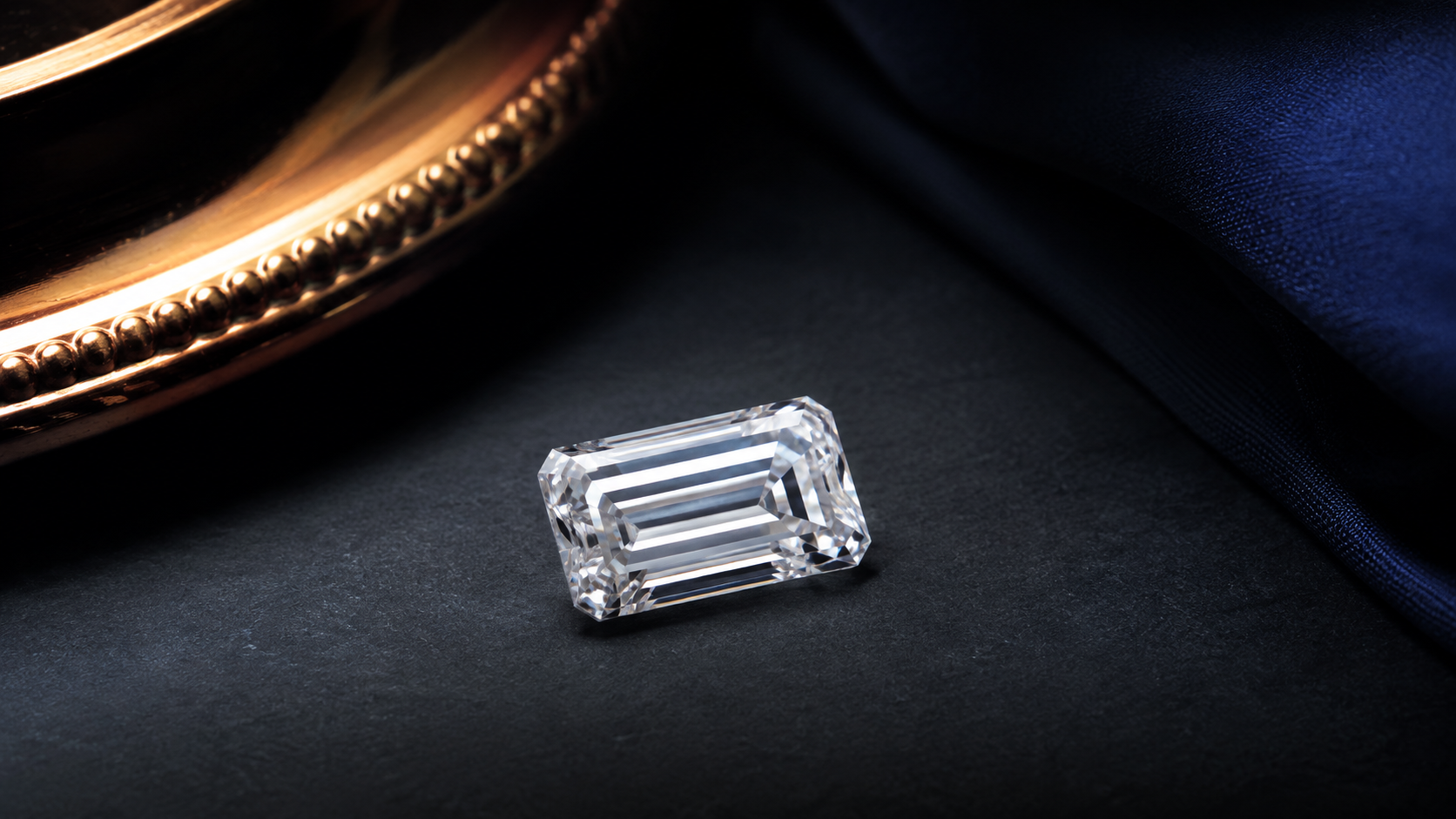
Most diamond cuts are designed to break light into as many small flashes as possible. An emerald cut diamond does the opposite. Its facets are long, parallel and few, arranged in steps around a large open table, and the result is not sparkle but a slow, mirror-like flash of light and dark as the stone moves. The trade calls this the hall of mirrors effect.
It is the most elegant of the classic shapes and the least forgiving. Everything in the stone is on display.
Why it shows more
A brilliant cut scatters light so thoroughly that inclusions and body colour are lost in the confusion. A step cut does not scatter. Its broad facets act as windows, and through them you see the interior of the stone with unusual clarity.
That has three consequences.
Colour is more visible. A G that reads white in a round can read faintly warm in an emerald cut, particularly at the ends where the stone is thinner. Most people find F to G comfortable for white metal and G to H for yellow gold, one grade above what they would accept in a round.
Inclusions are more visible. A VS2 that vanishes in a round can be found in an emerald cut, especially under the table. VS1 is the safe floor for most stones; a carefully checked VS2 with inclusions at the edges can work. SI grades need to be seen in person and are frequently not eye clean in this shape.
Cut quality is more visible. Poor symmetry, a table that is off centre, or steps that are uneven in width all show plainly. There is nowhere to hide.
Ratio and outline
Emerald cuts range from near square, which shades into the Asscher, through to long rectangles.
1.30 to 1.40 is the classic proportion. Clearly rectangular, balanced, not exaggerated.
1.40 to 1.50 is longer and leaner, and reads as more modern.
Below 1.25 starts to look square and loses the elongating effect that draws most people to the shape.
Check the corners. An emerald cut has cut corners, small diagonal facets that replace the sharp points. They should be the same size at all four corners. Uneven corners are a common flaw and become obvious once the stone is set against a straight band.
Windowing and the black centre
Two things to look for in a stone loose.
A window is a patch, usually in the centre, where light passes straight through without being reflected back. The stone looks glassy or you can see the surface beneath it. This happens when the pavilion is cut too shallow.
A dead centre is the opposite problem, a dark table caused by a pavilion cut too deep. Emerald cuts naturally show some dark flashes as they move; a permanent dark centre that does not change with angle is a fault.
Depth percentages in the low to mid sixties tend to avoid both.
Setting
The long straight sides of an emerald cut suit a plain band and a simple four-prong setting placed at the corners. Prongs on the corners protect the most vulnerable points and keep the outline uninterrupted. A bezel works well too and gives the stone a clean architectural frame.
Halos are possible but tend to fight the shape. The point of an emerald cut is its restraint.
Why choose it
Because it looks like nothing else. A good emerald cut does not glitter; it glows, with long flashes that move slowly across the stone as the hand turns. It looks larger than a round of the same weight because so much of its weight is in the spread. It reads as considered rather than showy.
The price of that is a better stone. Colour, clarity and cut all need to be a step higher than they would for a brilliant, and the stone needs to be seen loose before it is set. It is a cut for a buyer who is willing to look closely, which is exactly the kind of buyer it rewards.
Book a complimentary design consultation at the C'Garden atelier, The MET Corporate Towers, Kuala Lumpur: 010-766 7448 · hq@cgarden.com.my
C'Garden is an independent bespoke jeweller in Kuala Lumpur. We are not affiliated with, endorsed by, sponsored by or certified by any organisation, laboratory or brand named in this article. Third-party names are used only to refer factually to those organisations and their published standards. All text and imagery in this article is original work created by C'Garden.
Reference
Gemological Institute of America. (n.d.). Diamond clarity. GIA. https://www.gia.edu/diamond-clarity
All journal entries