
Designing From a Photo: What a Jeweller Can and Cannot Copy
A custom ring from photo references is how most bespoke work starts. What a jeweller can reproduce from an image, what is missing and where copying stops.
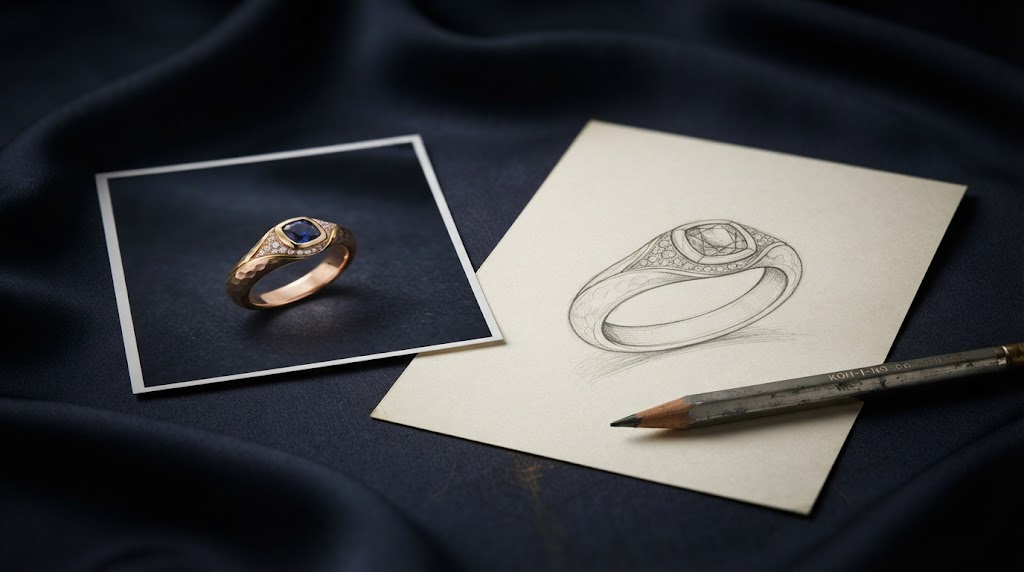
Almost every bespoke commission begins with a screenshot. Someone has seen a ring, saved the image, and wants to know whether a jeweller can make it. The honest answer to a request for a custom ring from photo references is: partly, and the interesting work is in the parts the photo does not show.
This is a guide to what a picture tells a workshop, what it hides, and where the line sits between inspiration and copying.
What a photo reliably gives
Overall silhouette. Whether the stone is round or oval, whether the band is plain or set, whether the setting is a halo or a solitaire. This is the easy part.
Proportion, roughly. How wide the band looks relative to the stone, how high the setting appears. Roughly, because photographs are taken with lenses that flatten or exaggerate, and product shots are often of rings made in a small sample size that would look different in yours.
Style vocabulary. A photo tells a jeweller what family the design belongs to: vintage-leaning, minimal, architectural, organic. That shapes every subsequent decision.
What a photo does not show
The side and the underside. Most reference images are from above or at a flattering three-quarter angle. The profile, the gallery, the way the band meets the head, and the depth of the whole thing are invisible, and those are the parts that decide comfort and durability.
Actual dimensions. A 1 carat stone and a 2 carat stone photograph identically if nothing is beside them for scale. The band might be 1.6mm or 2.4mm. Your finger size changes every proportion.
Metal colour, honestly. Studio lighting and editing shift gold colours considerably. A ring that reads as champagne in a photo may be plain yellow 750 in daylight.
Stone quality. A rendered image or a heavily retouched photo shows a stone with no inclusions, perfect colour and impossible sparkle. A real stone in the same setting will look like a real stone.
Whether it was ever real. A growing share of ring images online are CAD renders that were never made. Some are not manufacturable as shown, with prongs too thin to hold anything or stones that would fall through the setting.
How a workshop uses the image
A good jeweller treats the photo as a brief, not a blueprint. The usual sequence is: identify what the client actually responds to in the image (often one feature, not the whole ring), sketch two or three interpretations, agree on dimensions against the client's finger and stone, then model it in CAD and show it from every angle before anything is cast. The final piece resembles the photo in spirit and differs from it in every measurement.
Where copying becomes a problem
Distinctive branded designs are protected in most jurisdictions, and a reputable workshop will not reproduce a signature design that is clearly associated with a particular house. Malaysia's industrial design and copyright laws cover original jewellery designs, and beyond the legal question there is a practical one: a copy is never quite the original, and everyone who knows the original will see it.
Generic forms are not owned by anyone. A six-prong solitaire, a three-stone ring, a pavé halo, a plain band with a bezel: these are the shared grammar of the trade and can be made freely.
The test is simple. If the appeal of the design is its shape and construction, it can almost certainly be made. If the appeal is that it looks like a specific brand's piece, a workshop should decline, and you would be better served by something designed for you.
Bring more than one photo
The most useful brief is three or four images with a note on what you like in each: the stone shape from one, the band from another, the setting height from a third. That gives the jeweller enough to design something that is yours, rather than a slightly wrong version of someone else's.
Book a complimentary design consultation at the C'Garden atelier, The MET Corporate Towers, Kuala Lumpur: 010-766 7448 · hq@cgarden.com.my
C'Garden is an independent bespoke jeweller in Kuala Lumpur. We are not affiliated with, endorsed by, sponsored by or certified by any organisation, laboratory or brand named in this article. Third-party names are used only to refer factually to those organisations and their published standards. All text and imagery in this article is original work created by C'Garden.
Reference
Intellectual Property Corporation of Malaysia. (n.d.). Industrial design. MyIPO. https://www.myipo.gov.my/
Gemological Institute of America. (n.d.). Jewelry design and manufacturing. GIA. https://www.gia.edu/jewelry-design
All journal entries