
CVD vs HPHT: How Lab-Grown Diamonds Are Actually Made
CVD vs HPHT diamond is a question about two different factories, not two products. How each process works, what it leaves behind, and whether it matters.
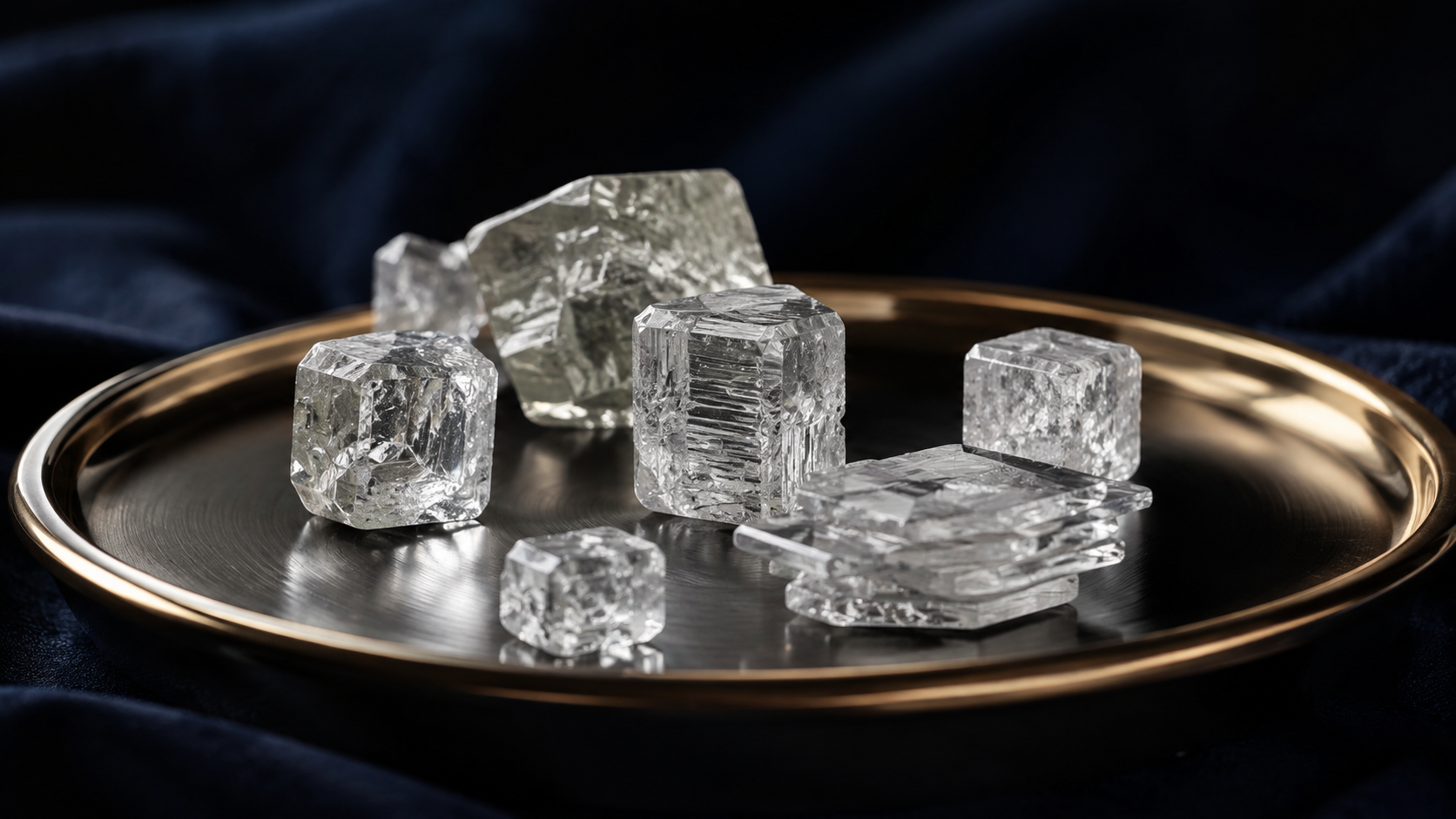
The letters on a grown diamond's report, CVD or HPHT, describe how the crystal was made. Buyers comparing a cvd vs hpht diamond often want to know which is better. The truthful answer is that both produce real diamond, that the finished stones are graded on the same scale, and that the differences lie mostly in what each process tends to leave behind.
HPHT: pressure and heat
High pressure, high temperature growth copies the conditions under which diamonds form in the earth, on a much faster timetable. A small diamond seed is placed in a cell with carbon and a metal solvent, typically iron, nickel or cobalt, and the cell is squeezed in a press to pressures of several gigapascals while being heated to well over a thousand degrees. The metal dissolves the carbon and deposits it on the seed as new diamond.
The process was developed in the 1950s for industrial abrasive and has been refined ever since. Gem-quality stones came later.
What it tends to leave behind. Tiny metallic inclusions from the solvent, sometimes visible under magnification as dark flecks, and occasionally enough for the stone to respond faintly to a strong magnet. Growth in a cuboctahedral pattern that a laboratory can detect under specialised light. Some HPHT stones carry a slight blue tint from boron, or a faint yellow from nitrogen, though colourless material is now standard.
CVD: gas and plasma
Chemical vapour deposition works at low pressure. Flat diamond seed plates sit in a vacuum chamber filled with a carbon-rich gas, usually methane with hydrogen. Microwaves or a hot filament turn the gas into plasma, freeing carbon atoms that settle on the seed plates layer by layer. The crystal grows upward as a slab over days or weeks.
What it tends to leave behind. Growth in fine parallel layers, which under crossed polarising filters can show as a banded strain pattern. A brownish tint in the as-grown crystal, common enough that many CVD stones are given a post-growth HPHT treatment to remove it. Occasional dark pinpoint inclusions of non-diamond carbon. CVD stones are usually very pure, with almost no nitrogen, the same category as the rarest natural diamonds.
CVD vs HPHT diamond: does the method matter to the stone
For appearance and durability, no. A well-cut colourless CVD stone and a well-cut colourless HPHT stone of the same grades are indistinguishable to the eye and to the wearer. Both are carbon in the diamond lattice, Mohs 10, with the same brilliance and fire.
For the report, slightly. Major laboratories state the growth method, and whether any post-growth treatment was applied. A CVD stone that has been HPHT treated to improve colour will say so. This is disclosure, not a defect, and it does not affect stability.
For price, marginally at most. Some buyers have a preference for one method and some sellers promote one over the other, but the market prices grown diamonds on their grades, not their origin story.
Where the differences show up in practice
Larger sizes. Both processes now produce stones well above three carats, but CVD has been scaling faster and accounts for most large gem material.
Fancy colours. Blue is easier to produce by HPHT with boron. Pink is usually made by treating stones after growth, from either process. Yellow can come from either.
Fluorescence. Some HPHT stones show a distinctive phosphorescence, a brief glow after ultraviolet light is switched off, which laboratories use as a screening clue. It is invisible in normal wear.
What to check
That the report names the growth method and any treatment. That the girdle inscription matches the report number. That the stone was graded by a laboratory whose standards you trust. And that the cut is good, because with grown diamond the material is cheap enough that there is no excuse for a poorly cut stone.
Beyond that, CVD vs HPHT is a question for the chemist rather than the buyer. The stone on the hand is diamond either way.
Book a complimentary design consultation at the C'Garden atelier, The MET Corporate Towers, Kuala Lumpur: 010-766 7448 · hq@cgarden.com.my
C'Garden is an independent bespoke jeweller in Kuala Lumpur. We are not affiliated with, endorsed by, sponsored by or certified by any organisation, laboratory or brand named in this article. Third-party names are used only to refer factually to those organisations and their published standards. All text and imagery in this article is original work created by C'Garden.
Reference
Gemological Institute of America. (n.d.). Laboratory-grown diamonds. GIA. https://www.gia.edu/laboratory-grown-diamond
All journal entries