
Cushion Cut Diamonds: Crushed Ice or Chunky Facets?
Two stones can both be a cushion cut diamond and look completely different. Chunky and crushed ice styles explained, and how to choose between them.
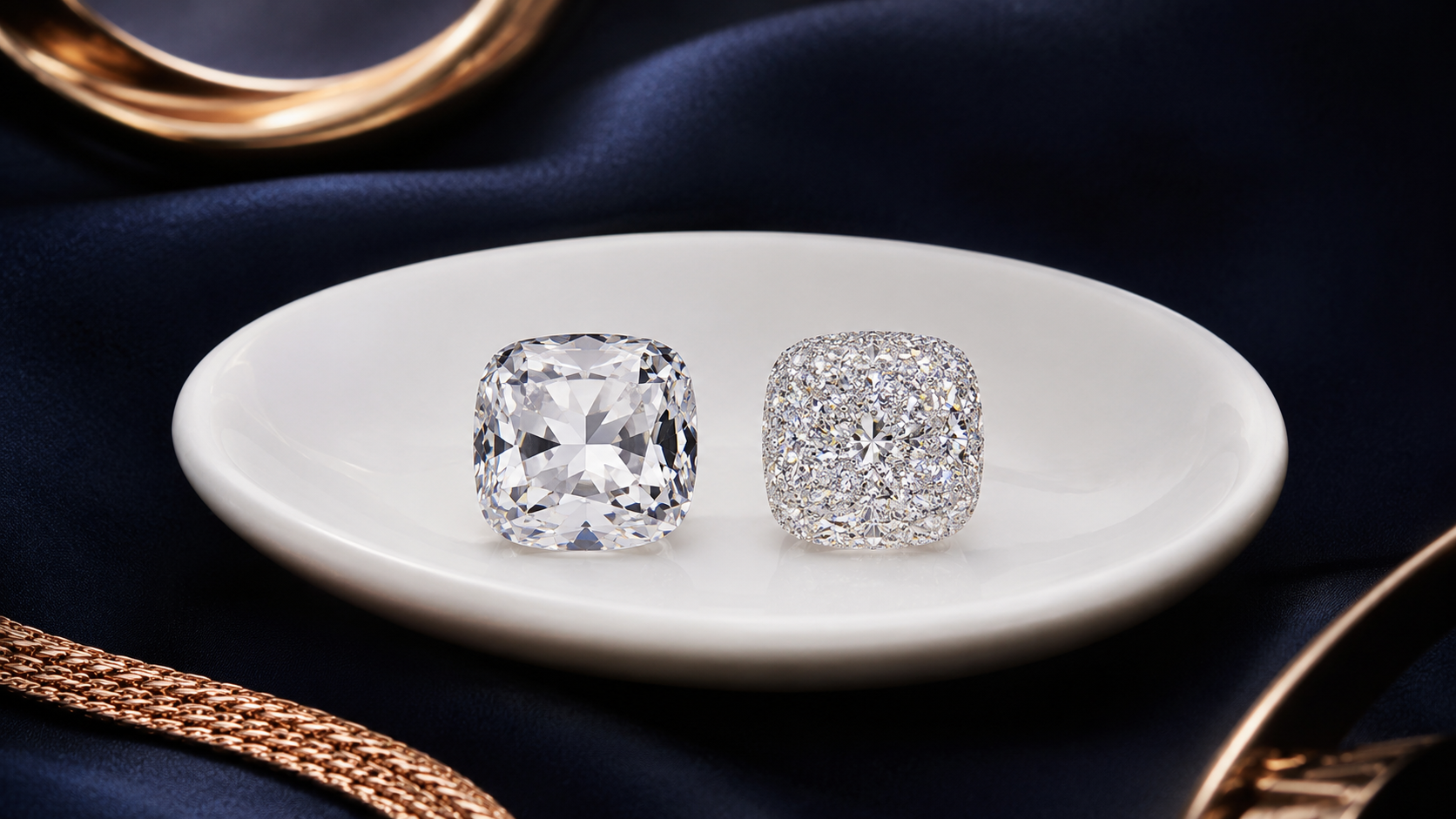
A cushion cut diamond is a square or rectangle with rounded corners and softly curved sides. That is the whole definition, and it hides the fact that two cushions can be faceted so differently that they barely look like the same shape. Choosing a cushion means choosing between two families first and a specific stone second.
The two families
Chunky cushions, sometimes called antique or old-style cushions, have a small number of large pavilion facets. Face up, you see distinct broad flashes of light and dark, a pattern of bold shapes not unlike a round brilliant seen through a soft lens. The light returns in big blocks. The stone has a clear structure you can read.
Crushed ice cushions have pavilion facets that are split and multiplied, so that the stone returns light as a fine, glittering texture with no clear pattern. The effect is often compared to looking into a bowl of broken ice, or the surface of water in sunlight. There is a great deal of sparkle and very little structure.
Neither is better. They are different, and most people have a strong preference within seconds of seeing them side by side.
What the report says
Laboratory reports do not use the words chunky or crushed ice. They typically describe cushions as either cushion brilliant or cushion modified brilliant.
A cushion brilliant has a facet arrangement closer to a round, with pavilion facets that run from the girdle to the culet. These are usually chunky.
A cushion modified brilliant has an extra row of facets added, which breaks the light up further. These are usually crushed ice, though the correlation is not perfect. Some modified brilliants are fairly chunky and some brilliants are quite glittery.
The report term is a hint, not a guarantee. The stone must be seen.
How each one behaves
Colour. Crushed ice cushions tend to show body colour more, because the many small reflections give the eye no white reference. Chunky cushions mask colour slightly better. For either, going one grade higher than you would in a round is a reasonable precaution.
Clarity. Crushed ice is very forgiving of inclusions. The scattered light hides them. Chunky cushions have larger facets that can act as windows, so an inclusion under the table is easier to see.
Light performance. Chunky cushions tend to be brighter in ordinary daylight, because large facets return light efficiently. Crushed ice cushions come alive under spotlights and in movement, where the fine sparkle reads as fire.
Perceived size. Crushed ice stones are often cut deeper to create their effect and can carry more of their weight in the pavilion. A chunky cushion of the same weight is frequently a little wider across.
Outline and ratio
Cushions come from near square, around 1.00 to 1.05 length to width, through to clearly elongated at 1.20 and above. Elongated cushions have grown popular because they combine the softness of the shape with the finger-lengthening effect of an oval.
Whatever the ratio, look at the corners. They should be evenly rounded and match each other. Cushions with one tighter corner are common and look wrong once set.
Choosing
See both types under the same light, ideally daylight from a window rather than a shop spotlight. Turn each stone slowly. Decide which pattern you like before you look at any report details, because no colour or clarity grade will make you love a facet pattern you dislike.
Then, within the family you prefer, apply the usual tests. Compare millimetre spread rather than carat weight. Check the plot for anything under the table. Ask for a video in ordinary light if you cannot see the stone loose.
A cushion is a warm, soft, old-fashioned shape with a very modern range of options inside it. The report will not choose for you. That is the one decision the buyer has to make in person.
Book a complimentary design consultation at the C'Garden atelier, The MET Corporate Towers, Kuala Lumpur: 010-766 7448 · hq@cgarden.com.my
C'Garden is an independent bespoke jeweller in Kuala Lumpur. We are not affiliated with, endorsed by, sponsored by or certified by any organisation, laboratory or brand named in this article. Third-party names are used only to refer factually to those organisations and their published standards. All text and imagery in this article is original work created by C'Garden.
Reference
Gemological Institute of America. (n.d.). Diamond cut. GIA. https://www.gia.edu/diamond-cut
All journal entries