
Choosing Earrings for Your Face Shape
Earrings for face shape, explained as proportion rather than rules: how length, width and line change what a face looks like, shape by shape.
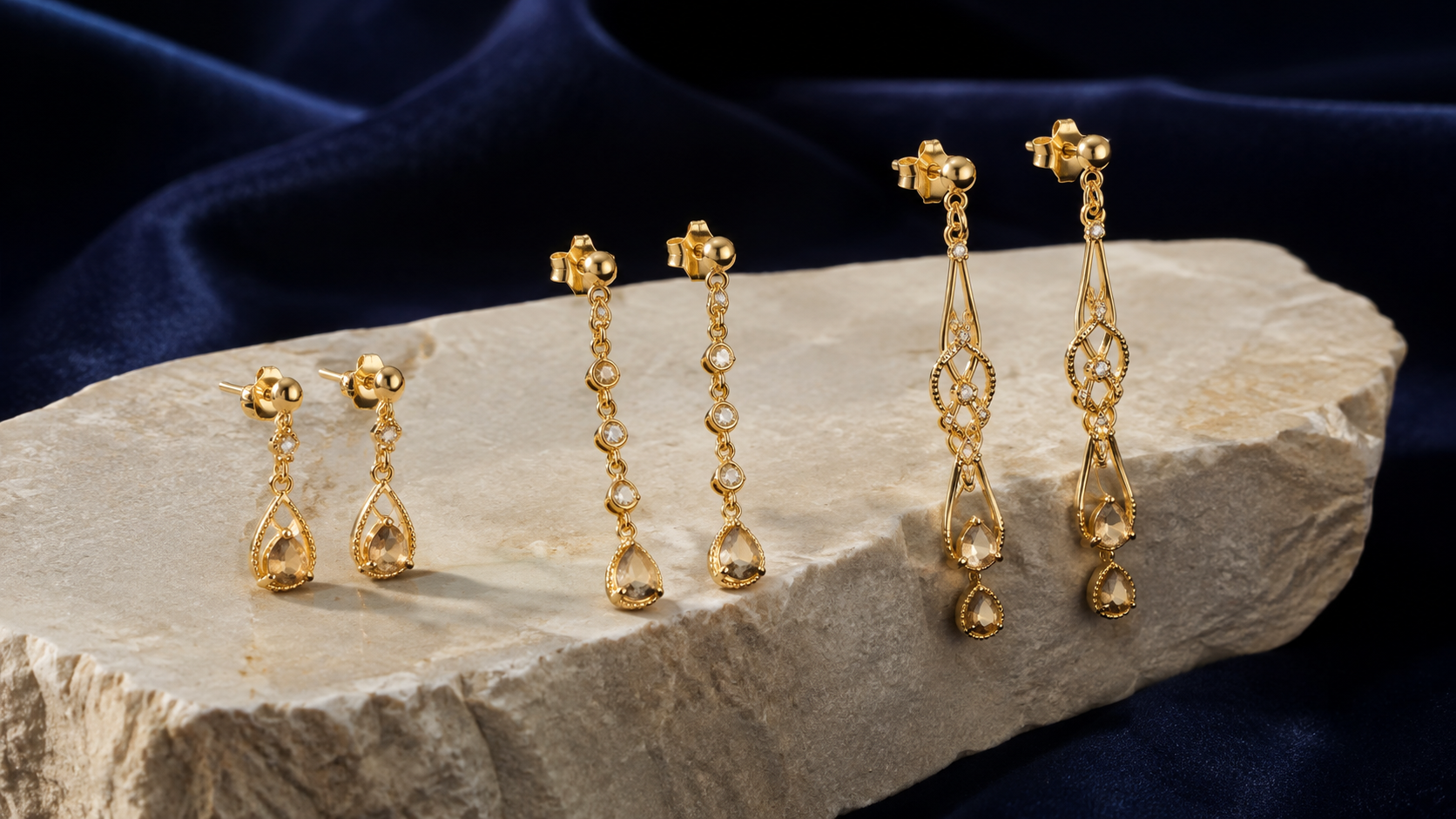
Advice about earrings for face shape is usually delivered as a table of rules. The rules are not wrong, but they hide the simple idea underneath them, which is that an earring is a line drawn beside the face, and the eye reads the face and the line together.
Once you see it that way, you can make your own decisions.
The three variables
Length. A long earring adds a vertical line. It draws the eye down and makes a face read longer. A short earring, a stud or a huggie, adds nothing vertical and leaves the face's own proportions alone.
Width. A wide earring, a round hoop or a broad cluster, adds horizontal weight at whatever height it sits. Width at the jaw makes the jaw read wider; width at the earlobe fills in below the cheekbone.
Line. Angular earrings, with straight edges and points, echo angular features and soften round ones by contrast. Curved earrings do the opposite.
Every piece of face-shape advice is a combination of these three.
Round faces
Width is roughly equal to length, with a soft jaw and full cheeks. Length helps: a slim drop or a long linear earring adds the vertical the face does not have. Angular shapes add definition. Wide round hoops repeat the roundness and are the usual thing to avoid, though a very slim hoop reads as a line rather than a shape and is fine.
Long or oblong faces
Length is clearly greater than width. Here the vertical is already present, so long drops extend it further. Studs, huggies, small clusters and hoops that sit at or above the jaw add width where it is welcome. Curves soften.
Oval faces
Balanced proportions, slightly longer than wide. Almost everything works, which is why oval is the shape used to demonstrate earrings. The only caution is scale: very large pieces can overwhelm delicate features.
Heart-shaped faces
Wide at the forehead and cheekbones, narrowing to a pointed chin. Width low down balances the point. Teardrops, chandeliers and earrings that widen towards the bottom do this well. Shapes that are widest at the top repeat the forehead and are less flattering.
Square faces
Strong, angular jaw, forehead about as wide as the jaw. Curves soften: hoops, round drops, oval shapes. Length slims. Sharp geometric earrings that end exactly at the jawline repeat the angle and are usually the thing to avoid.
Diamond faces
Narrow forehead and chin, widest at the cheekbones. Width at the bottom, as for heart shapes, and softness. Studs sit exactly at the widest point and can emphasise it, so small drops are often better.
Earrings for face shape: what matters more
Neck length and hair. A long earring on a short neck has nowhere to go. Hair worn up or short exposes the whole earring; long loose hair hides most of it and makes studs pointless.
Scale. Fine features suit fine earrings. Strong features can carry weight. This overrides every shape rule.
Occasion. The same face wants a stud at work and a drop at a wedding.
Using this in a bespoke commission
Bring a photograph of yourself facing the camera with hair back. The designer can lay candidate shapes against it and show you, in proportion, what each does. Adjusting drop length by five millimetres is a small change on paper and a visible one on a face. That precision is the whole reason to make earrings rather than buy them.
Book a complimentary design consultation at the C'Garden atelier, The MET Corporate Towers, Kuala Lumpur: 010-766 7448 · hq@cgarden.com.my
C'Garden is an independent bespoke jeweller in Kuala Lumpur. We are not affiliated with, endorsed by, sponsored by or certified by any organisation, laboratory or brand named in this article. Third-party names are used only to refer factually to those organisations and their published standards. All text and imagery in this article is original work created by C'Garden.
Reference
Jewelers of America. (n.d.). Buying jewelry. Jewelers of America. https://www.jewelers.org/buying-jewelry
All journal entries