
What to Look For in a Kuala Lumpur Jeweller
KL has everything from mall chains to bench workshops. Six questions that separate a jeweller who makes things from a jeweller who resells them.
Kuala Lumpur is well supplied with jewellery. Mall chains, the gold shops around Jalan Masjid India, independent ateliers, and a growing number of online-only sellers. They are not the same kind of business, and the right one depends on what you are buying.
First, decide which you need
A gold shop is the right place for weight-based purchases, chains, bangles, 916 pieces bought partly for value. Efficient, competitive, transparent on rate.
A chain retailer is good for trying many finished styles quickly, and for a warranty network across branches.
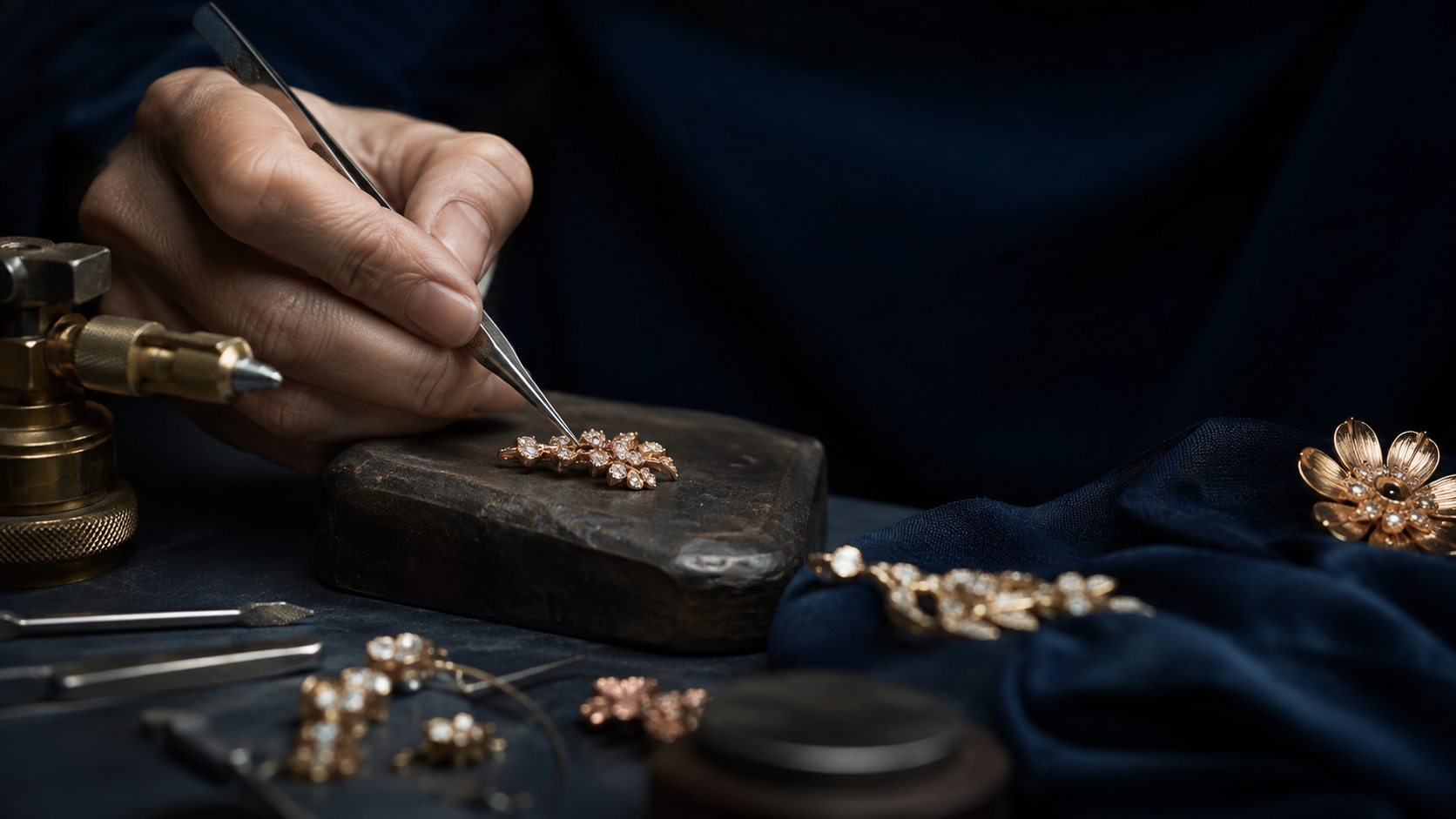
A bench jeweller or atelier is for anything made to you: a stone reset, a design that must fit an existing band, an unusual hand.
Paying atelier prices for a plain chain is a waste. So is asking a volume retailer to solve an unusual commission.
Six questions worth asking
1. Do you make on site, or do you send work out? Both are legitimate. It changes turnaround and who is accountable when something needs adjusting.
2. Can I see the CAD before you cast? For any custom work the answer should be yes, without hesitation.
3. What is the making charge, separately from the metal? A jeweller who cannot split the number is not necessarily dishonest, but you cannot compare quotes without it.
4. What happens if a stone comes loose in six months? Ask what is covered and for how long. Get it in writing.
5. Is there an independent report for this stone? For any significant diamond, a report from a recognised laboratory, not an in-house certificate on the seller's own letterhead.
6. What will you buy it back for? Even if you never intend to sell, the answer tells you how the price is constructed.
Signals worth noticing
Good sign: they talk you out of something. A jeweller who suggests a smaller stone with a better cut, or 18k instead of platinum, is thinking about your outcome.
Good sign: they ask about the wearer's hands and habits before showing you anything.
Bad sign: urgency. Fine jewellery is not a perishable product. A price that expires this afternoon is a sales technique, not a market condition.
Bad sign: vagueness about origin or grading on a stone above a meaningful size.
On price comparison
The cheapest quote for "a one carat diamond ring" is almost always a different specification, not a better deal. Compare cut grade, colour, clarity, metal fineness and finished weight. Once those match, compare price.
Most apparent bargains disappear at that point. The ones that survive are worth taking seriously.
Book a complimentary design consultation at the C'Garden atelier, The MET Corporate Towers, Kuala Lumpur: 010-766 7448 · hq@cgarden.com.my
C'Garden is an independent bespoke jeweller in Kuala Lumpur. We are not affiliated with, endorsed by, sponsored by or certified by any organisation, laboratory or brand named in this article. Third-party names are used only to refer factually to those organisations and their published standards. All text and imagery in this article is original work created by C'Garden.
Reference
Jewelers of America. (n.d.). Jewelry buying guides. Jewelers of America. https://www.jewelers.org/buying-jewelry/jewelry-buying-guides
All journal entries