
Choosing a Diamond Pendant: Stone, Bail and Chain
A diamond pendant necklace is three decisions, not one. Choosing the stone for distance, the bail that keeps it facing forward, and a chain that lasts.
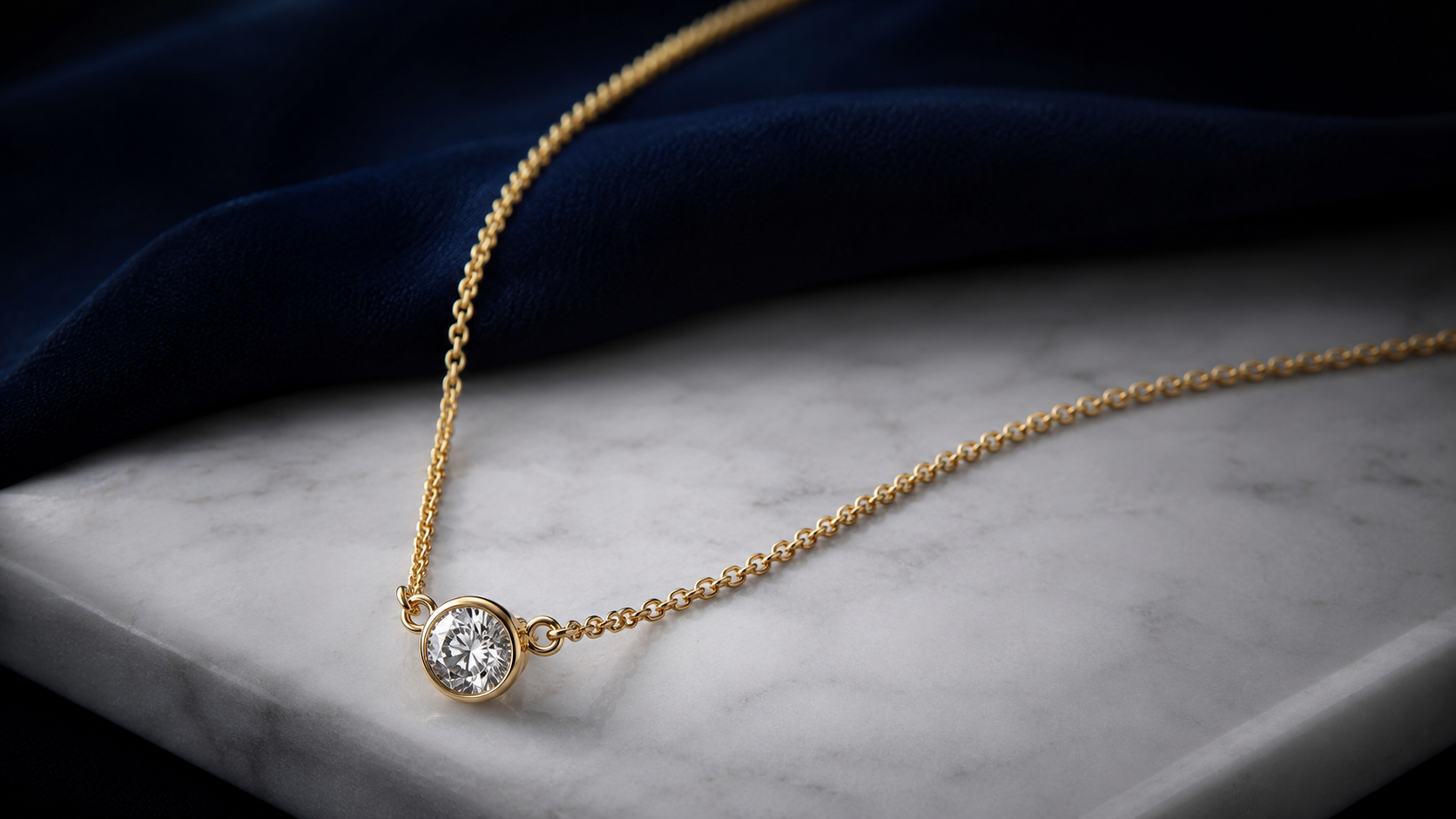
A diamond pendant necklace is usually bought as a single object and usually fails as one of its parts. The stone gets the attention; the bail and the chain get the wear. Getting all three right is what separates a pendant that hangs well for decades from one that flips, tangles or is found on the floor of a taxi.
The stone
A pendant is seen from a metre away, against skin or fabric, and almost never under magnification. That changes the priorities.
Colour. Anything from G to J reads white on the chest. On a yellow gold bail, even K looks fine. Spending on D to F colour here buys nothing visible.
Clarity. SI1 with no inclusions visible to the naked eye is the practical floor. Below that, clouds can dull the stone at a distance.
Cut. The one grade that shows. A pendant moves constantly and a well-cut stone flashes as it moves. A deep, poorly cut stone looks small and dark from across a room.
Shape. Round is the most brilliant and the easiest to set securely. Pears and ovals hang naturally with their point down and make the stone look larger for its weight. Emerald cuts are quieter and show every bit of dirt on the pavilion.
Size. Half a carat is a clear everyday pendant. A full carat is noticeable. Beyond that the chain and bail need to be built to carry it.
The bail
The bail is the loop that joins pendant to chain, and it decides whether the stone faces forward.
Fixed bail. Soldered rigidly to the setting. Simple and strong, but the pendant can only hang as the bail allows, and on a fine chain a fixed-bail solitaire will sometimes flip to show its back.
Hinged bail. Attached with a small pin so the pendant swings. Lets the stone settle face forward and follows the body. The pin is a wear point, so it should be substantial.
Hidden or integrated bail. The chain runs through a tube behind the setting, so the stone appears to float. Elegant, and the style that flips most easily unless the tube is set high enough to keep the weight low.
Enhancer bail. Opens to clip over a chain or a strand of pearls. Useful for a pendant meant to move between necklaces.
Whatever the type, the bail opening must suit the chain. A bail that is too narrow for the clasp means the chain can never be changed. A bail that is far too wide lets the pendant slide and twist.
The chain for a diamond pendant necklace
Chains fail at three places: the clasp, the jump ring beside the clasp, and wherever the bail rubs.
Style. Cable chains are the standard and repair easily. Box and wheat chains are stiffer and hold a pendant centred. Rope chains are strong but heavy. Snake chains are smooth and elegant but kink permanently if bent sharply, and they are the hardest to repair.
Thickness. Match the chain to the pendant's weight. A very fine chain under a one-carat pendant will stretch at the bail and eventually break there. Roughly, a heavier pendant wants a chain of at least one millimetre, and a light solitaire can sit on something finer.
Length. Forty centimetres sits at the base of the neck, forty-five at the collarbone, fifty to fifty-five just below. Most solitaire pendants are worn at forty-two to forty-five. Try the length on before committing, since neck sizes vary as much as ring sizes.
Clasp. A lobster clasp is stronger and easier to operate than a spring ring. On any chain of value, the clasp and its jump ring should be soldered closed, not simply bent shut.
Metal. The chain should be the same alloy as the pendant. In Kuala Lumpur humidity, a plated chain next to a solid gold pendant will discolour long before the pendant does.
Care
Fasten the clasp before storing so the chain cannot knot. Take it off to sleep and to swim. Have the bail pin and the clasp checked whenever the piece is cleaned. A pendant that is looked after this way needs almost nothing else for a very long time.
Book a complimentary design consultation at the C'Garden atelier, The MET Corporate Towers, Kuala Lumpur: 010-766 7448 · hq@cgarden.com.my
C'Garden is an independent bespoke jeweller in Kuala Lumpur. We are not affiliated with, endorsed by, sponsored by or certified by any organisation, laboratory or brand named in this article. Third-party names are used only to refer factually to those organisations and their published standards. All text and imagery in this article is original work created by C'Garden.
Reference
Gemological Institute of America. (n.d.). Diamond cut. GIA. https://www.gia.edu/diamond-cut
All journal entries