
Checking Your Own Gold at Home: What You Can and Cannot Verify
How to check gold purity at home: which simple tests tell you something, which tell you nothing, and why a proper answer still needs a jeweller's XRF.
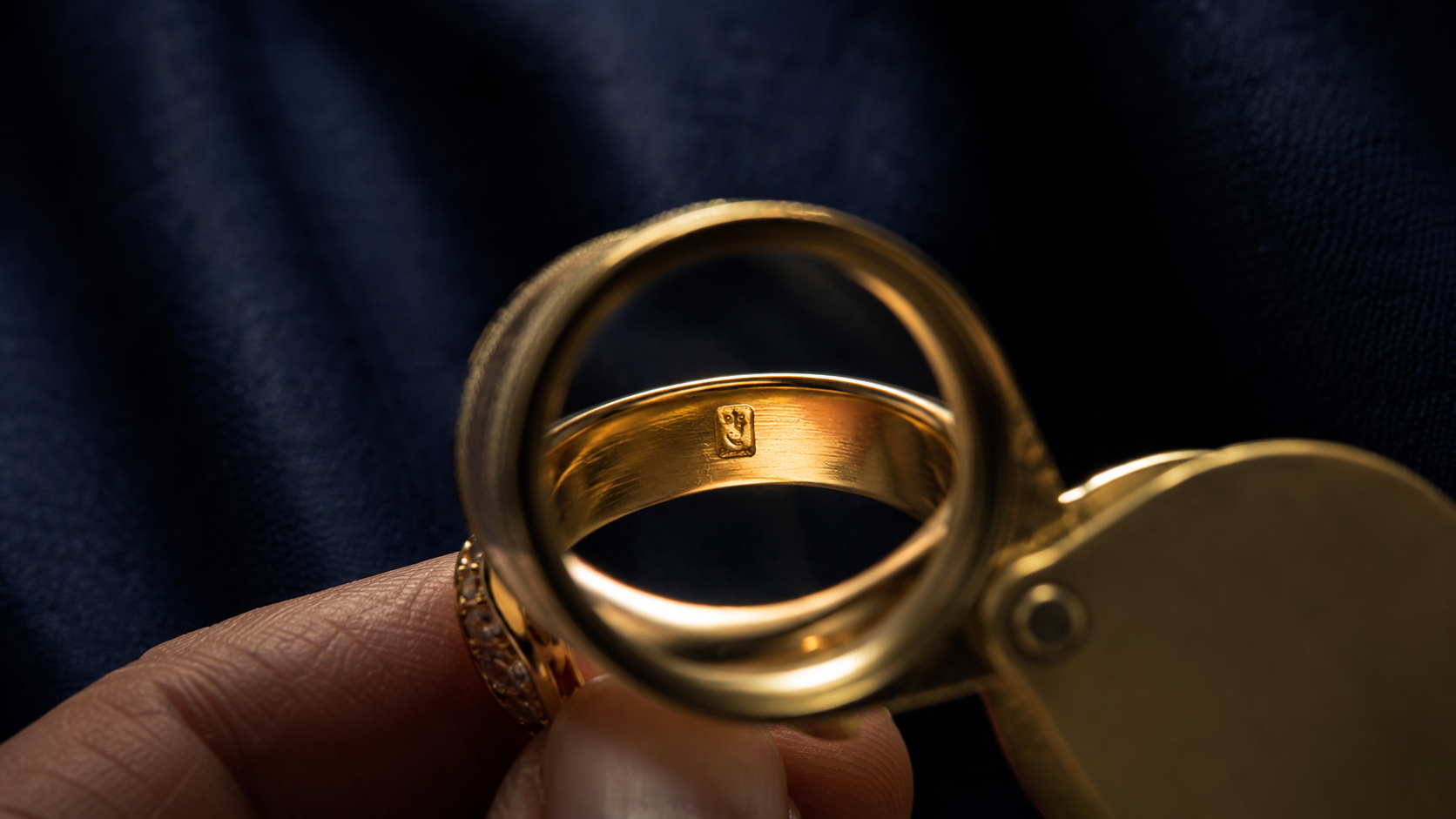
Every so often a piece of gold arrives without a story. An inheritance with no receipt, a market purchase, a gift from someone who is no longer around to ask. The natural question is whether it is what it appears to be, and the internet is full of advice on how to check gold purity at home.
Some of that advice is useful. Some of it is harmless but uninformative. A little of it will damage the piece. Here is an honest sorting.
What you can genuinely check
The hallmark. With a loupe or a phone camera on macro, look inside the ring, on the clasp, or on the bangle's inner surface. Malaysian pieces are commonly stamped 916, 750, 585 or 375 for 22, 18, 14 and 9 karat respectively, often with a maker's mark. A clear, crisp stamp is a good sign. A blurred or absent one is not proof of anything, but it moves the piece into the "test properly" pile.
Weight against volume. Gold is dense: pure gold is about 19.3 grams per cubic centimetre, and 916 alloy is still well above 17. A piece that feels light for its size, or that floats a suspicion when you handle it beside a known piece, is worth questioning. This is a feel, not a measurement, unless you have a fine scale and a way to measure displacement.
The magnet. Gold is not magnetic. If a strong magnet pulls the piece, it contains a significant amount of iron or nickel and is not solid gold. Passing the magnet test proves very little, since brass, copper and many plating bases are also non-magnetic.
Wear points. Look at edges, the underside of a ring, the ends of a chain. Plated pieces wear through to a different colour at the points of most friction. Solid gold wears to more gold.
What tells you almost nothing
The bite test. It marks soft metals, including lead. It also marks your teeth and your gold.
The ceramic streak. Dragging gold across an unglazed tile is said to leave a gold streak, while fakes leave black. In practice it scratches the piece and the result is hard to read on alloys.
Colour. 916 gold has a distinctive rich yellow, but so does well-made gold plating, and 18 karat comes in several colours by design.
Skin discolouration. Green marks on the finger are usually a reaction between skin chemistry and copper in the alloy, which is present in real 916 and 750 too. They are not a reliable fake indicator.
What you should not do at home
Acid testing. Kits are sold online. They work by scratching the piece and applying nitric acid solutions of different strengths. Done badly, they leave permanent marks and can misread plated pieces with thick layers. Done well, they still only test the surface. Leave it to a bench.
What a jeweller can do that you cannot
XRF analysis. A handheld X-ray fluorescence analyser reads the alloy composition of the surface in seconds, without any damage. Most established gold shops in Kuala Lumpur have one and will test a piece for a small fee or free with a purchase.
Density measurement. A proper specific gravity test with a calibrated scale gives a figure that is hard to fake for solid pieces.
Fire assay. The definitive method, destructive, used by refiners. Not for jewellery you intend to keep.
A sensible sequence
Check the hallmark and wear points at home. If both are reassuring and the source is trustworthy, you are probably fine. If either raises a question, or the piece is heavy enough that the answer matters, take it for an XRF reading. Ten minutes at a counter settles what an afternoon of home tests cannot.
Book a complimentary design consultation at the C'Garden atelier, The MET Corporate Towers, Kuala Lumpur: 010-766 7448 · hq@cgarden.com.my
C'Garden is an independent bespoke jeweller in Kuala Lumpur. We are not affiliated with, endorsed by, sponsored by or certified by any organisation, laboratory or brand named in this article. Third-party names are used only to refer factually to those organisations and their published standards. All text and imagery in this article is original work created by C'Garden.
Reference
World Gold Council. (n.d.). About gold. World Gold Council. https://www.gold.org/about-gold
All journal entries