
Checking a New Piece for Defects: Porosity, Gaps and Loose Stones
A practical jewellery quality check for collection day: how to spot porosity, seam gaps, uneven prongs and loose stones before you accept a new piece.
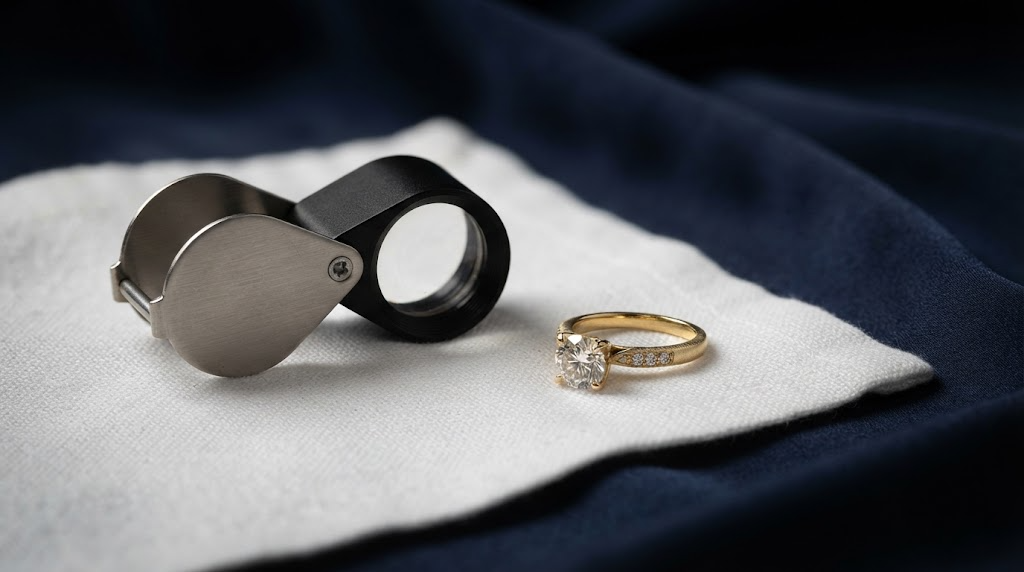
Collection day is the one moment when a defect costs nothing to fix. A jewellery quality check takes ten minutes, needs a loupe and a good lamp, and is entirely reasonable to ask for. A confident workshop will hand you the loupe before you ask.
This is what to look at, in the order a bench jeweller would.
Porosity
What it is. Cast gold and platinum can trap tiny gas bubbles as the metal cools. On the surface they show as pinpricks, sometimes in a small cluster, usually on thicker sections such as the shank or a heavy bezel.
Why it matters. A few microscopic pores in a low-stress area are cosmetic. Porosity along a prong, a hinge or the base of a claw is structural, because the metal there is doing work.
How to check. Turn the piece slowly under a lamp with the loupe. Polished surfaces should be mirror-flat. Any speckle that does not wipe off is a pore. Look at the inside of the shank too, where polishing is harder and pores are more often left.
Seams and gaps
Where they hide. Where a head is soldered to a shank, where a bail meets a pendant, where two halves of a hinged bangle join. Well-executed joints are invisible. Poor ones show a faint line, a colour change or a tiny step.
The fingernail test. Run a nail across every joint. It should glide. A catch means a gap or a step, and a gap is a place for dirt and, later, a crack.
Under a bezel. Light should not show between the metal wall and the stone. A gap means the bezel was not fully burnished down, and the stone will eventually move.
Prongs and stone security
Count and compare. Prongs should be the same height, the same thickness and evenly spaced. One shorter prong is the one that fails first.
Tips. Each prong tip should be rounded or neatly shaped, sitting on the crown of the stone with no sharp edge. Snagging a jumper is the usual early warning of a rough tip.
The tap test. Hold the piece close to your ear and tap it gently with a fingernail. A secure stone is silent. A faint rattle means a loose stone, and it must go back to the bench before you leave.
Pavé and channels. Sight along a row of small stones. They should sit level, at the same height, with no stone tilted. Press each one lightly with a wooden toothpick; none should rock.
Finish and symmetry
Polish. Look for fine scratches left by the last abrasive stage, especially in recesses. A dull haze in a corner means a stage was skipped.
Symmetry. Hold a ring upright and look straight down the finger hole. The head should sit centrally over the shank. Look from the side; a stone should be level, not tilted.
Engraving and hallmarks. Text should be crisp and legible under the loupe, with no smeared strokes.
Function
Clasps. Open and close every one ten times. It should snap decisively and hold under a gentle pull.
Hinges and links. Movement should be smooth with no clicking. Earring posts should be straight and butterflies should grip.
What to do if the jewellery quality check finds something
Say so, plainly. Porosity, a gap or a loose stone found on collection day is a workshop matter, and a reputable workshop will correct it without discussion. Accepting a piece and reporting the same fault a month later is harder for both sides, because wear becomes part of the conversation.
A quality check is not an accusation. It is the same inspection the workshop should already have done, repeated by the person who will wear the piece for decades.
Book a complimentary design consultation at the C'Garden atelier, The MET Corporate Towers, Kuala Lumpur: 010-766 7448 · hq@cgarden.com.my
C'Garden is an independent bespoke jeweller in Kuala Lumpur. We are not affiliated with, endorsed by, sponsored by or certified by any organisation, laboratory or brand named in this article. Third-party names are used only to refer factually to those organisations and their published standards. All text and imagery in this article is original work created by C'Garden.
Reference
Jewelers of America. (n.d.). Jewelry repair and care. Jewelers of America. https://www.jewelers.org/buying-jewelry/jewelry-repair-and-care
All journal entries