
Buying Diamond Stud Earrings: Size, Setting and Backs
Diamond stud earrings are the simplest piece to buy badly. Total versus per-stone weight, the three common settings, and why the backs matter most.
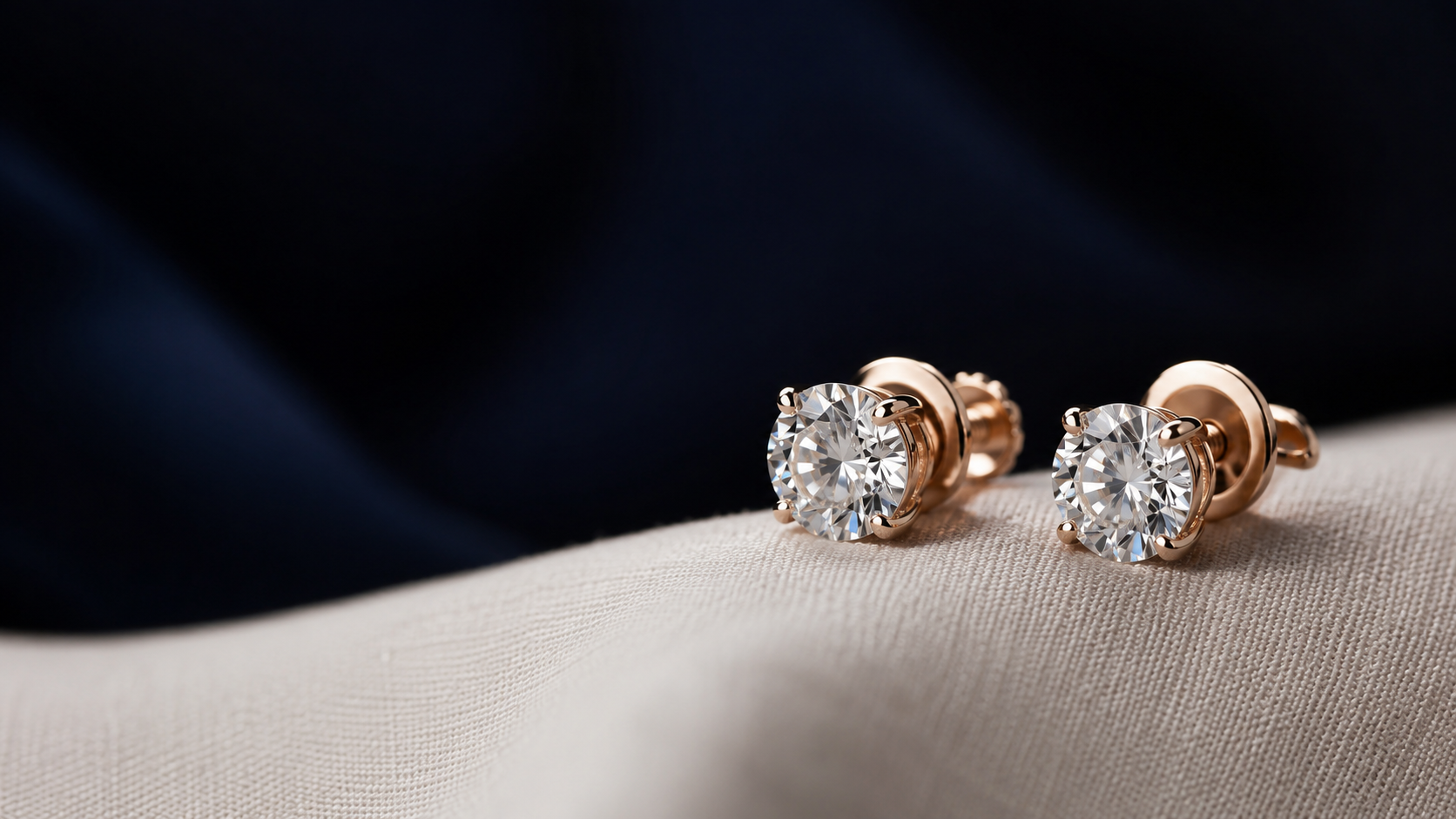
Diamond stud earrings look like the easiest purchase in fine jewellery: two stones, two posts, done. They are also the piece most often lost, most often bought in the wrong size and most often sold with a misleading weight. A few minutes on the details saves a good deal of regret.
Total weight is not per-stone weight
Studs are advertised by total carat weight, the two stones added together. A pair described as one carat is two half-carat stones, each about 5.1 millimetres across. A pair of one-carat stones is two carats total and each stone is around 6.5 millimetres. The difference on the ear is large and the difference in price is larger.
Always ask for the weight and diameter of each stone. Quarter-carat stones sit at about 4.1 millimetres and are the everyday size for many people. Half carats read clearly across a room. Anything above three quarters of a carat each is a statement, and heavier stones start to droop unless the setting and backs are up to it.
Grades that matter less, and one that matters more
Earrings are seen from further away than rings and rarely under a loupe. Colour in the H to J range looks white on the ear, especially in yellow gold. Clarity of SI1, with inclusions that are not visible face up, is sensible. Paying for D colour and flawless clarity in a stud is paying for something nobody will see.
Cut, on the other hand, is worth every ringgit. A stud is a stone on a post with nothing else to look at, and a well-cut stone throws light back while a deep one looks small and dark. Matching also matters: two stones of the same diameter, colour and cut, checked side by side.
The three common settings
Four-prong basket. The stone sits upright in a small cage with four claws. It holds the diamond securely, shows the most stone and sits slightly higher on the lobe. The standard choice for larger stones.
Three-prong martini. A cone shape that tapers to the post, so the stone sits closer to the ear and the setting is nearly invisible from the front. Elegant, but three prongs offer less redundancy, and heavier stones in martini settings can tilt forward over time.
Bezel. A rim of metal around the stone. The most secure and the most snag-proof, ideal for anyone who sleeps in earrings or has small children. It hides a little of the stone's edge and reads slightly smaller.
For everyday wear, a basket setting with a post positioned slightly above centre helps the stone sit upright rather than drooping.
Backs are where studs are lost
Friction or push backs. A grooved post and a butterfly clip. Convenient, and the way most studs are lost. The clip loosens with use and slides off in a scarf or a pillowcase.
Screw backs. A threaded post and a back that winds on. Much more secure. The threads can wear over years and the backs are fiddly to put on, but for stones of value they are the sensible default.
Locking backs. Spring-loaded backs that clamp onto a plain post and release with a squeeze. Secure, easy to use and increasingly common. A good choice for anyone who finds screw backs awkward.
Whatever the type, the post should be a reasonable thickness, and the back should be comfortable enough that it is not left loose.
Metal
18k gold and platinum both hold prongs well. White gold and platinum disappear behind a white stone; yellow gold frames it and warms a lower colour grade. Because studs sit against skin all day in a humid climate, the post and back should be of the same alloy as the setting, not a cheaper metal, to avoid reaction and corrosion.
Before you buy diamond stud earrings
Ask for the weight and diameter of each stone, not the pair. See them side by side in daylight. Try the backs and decide whether you can manage them daily. And insist on a report for anything above about a third of a carat per stone, with an inscription you can check.
Book a complimentary design consultation at the C'Garden atelier, The MET Corporate Towers, Kuala Lumpur: 010-766 7448 · hq@cgarden.com.my
C'Garden is an independent bespoke jeweller in Kuala Lumpur. We are not affiliated with, endorsed by, sponsored by or certified by any organisation, laboratory or brand named in this article. Third-party names are used only to refer factually to those organisations and their published standards. All text and imagery in this article is original work created by C'Garden.
Reference
Jewelers of America. (n.d.). Buying jewelry. Jewelers of America. https://www.jewelers.org/buying-jewelry
All journal entries