
Buying an Emerald: Why Inclusions Are Expected
An emerald without inclusions should make you suspicious rather than pleased. What to look for, what treatment is normal, and how to keep one intact.
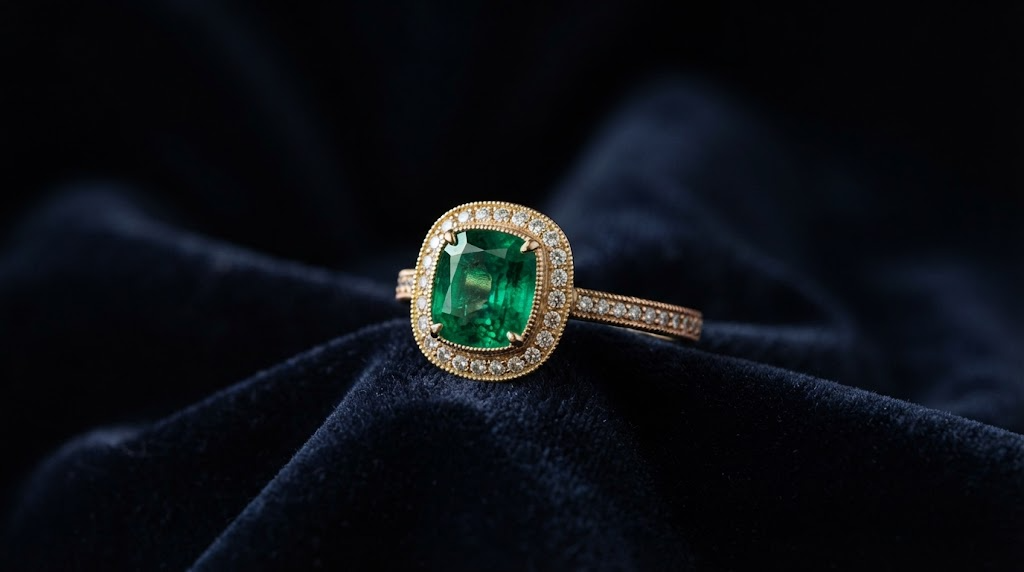
Emerald is judged by rules almost opposite to those for diamond. Applying diamond thinking to an emerald leads people to buy badly, or to reject good stones.
Colour is nearly everything
For emerald, colour dominates value in a way clarity never does.
What is sought is a vivid, saturated, slightly bluish green, neither so dark it goes black in low light nor so light it reads as green beryl.
Tone matters as much as hue. A stone that looks magnificent under bright shop lighting can go flat and dark in a restaurant. Always look at a coloured stone in more than one light, including somewhere dim.
Inclusions are normal, and named
Emeralds are famously included. The trade calls the internal landscape jardin, garden, because it looks like foliage inside the stone.
An eye-clean emerald is rare and priced accordingly. A modest, evenly distributed jardin is completely normal and is not a defect.
What matters is where the inclusions are and what they do:
- Inclusions that reach the surface create weak points and are a genuine concern
- Inclusions clustered in one area may affect durability locally
- Inclusions that dull the stone's transparency reduce beauty and value
- Scattered internal features that do not affect brilliance are simply the nature of the material
If a seller shows you a large, cheap, flawless emerald, be careful. It is more likely to be synthetic, or another green stone, than a bargain.
Treatment: assume oil
The overwhelming majority of emeralds on the market are treated with oil or resin, which fills surface-reaching fractures and improves apparent clarity.
This is accepted trade practice and not a scandal. What matters is disclosure and degree, reports describe the extent as minor, moderate or significant. Less treatment, higher value.
Two practical consequences:
Never put an emerald in an ultrasonic cleaner. It can drive the oil out and leave the stone looking worse than before.
Treatment is not permanent. Oil can dry out over many years. Re-oiling is a normal service, not a repair.
Durability, and choosing a setting
Emerald is reasonably hard but relatively brittle, because of those internal fractures. It chips more readily than sapphire or ruby.
This should shape the setting:
- Protected settings, bezel, or prongs that cover the corners, are wise
- The emerald cut exists partly for this reason: cut corners are less vulnerable than points
- Consider whether a daily-wear ring is the right home. Emerald makes a superb pendant or earring, where it is knocked far less
Practical advice
Buy the colour you love, accept a garden, insist on disclosure of treatment, and set it protectively. Clean it with a soft cloth and lukewarm soapy water, never ultrasonic, never steam.
Book a complimentary design consultation at the C'Garden atelier, The MET Corporate Towers, Kuala Lumpur: 010-766 7448 · hq@cgarden.com.my
C'Garden is an independent bespoke jeweller in Kuala Lumpur. We are not affiliated with, endorsed by, sponsored by or certified by any organisation, laboratory or brand named in this article. Third-party names are used only to refer factually to those organisations and their published standards. All text and imagery in this article is original work created by C'Garden.
Reference
Gemological Institute of America. (n.d.). Gem encyclopedia. GIA. https://www.gia.edu/gem-encyclopedia
All journal entries