
Blue Topaz: Why It Is Affordable and What Treatment Means
Almost every blue topaz in a shop started colourless. How irradiation and heating make the colour, why the stone is affordable and how to care for it.
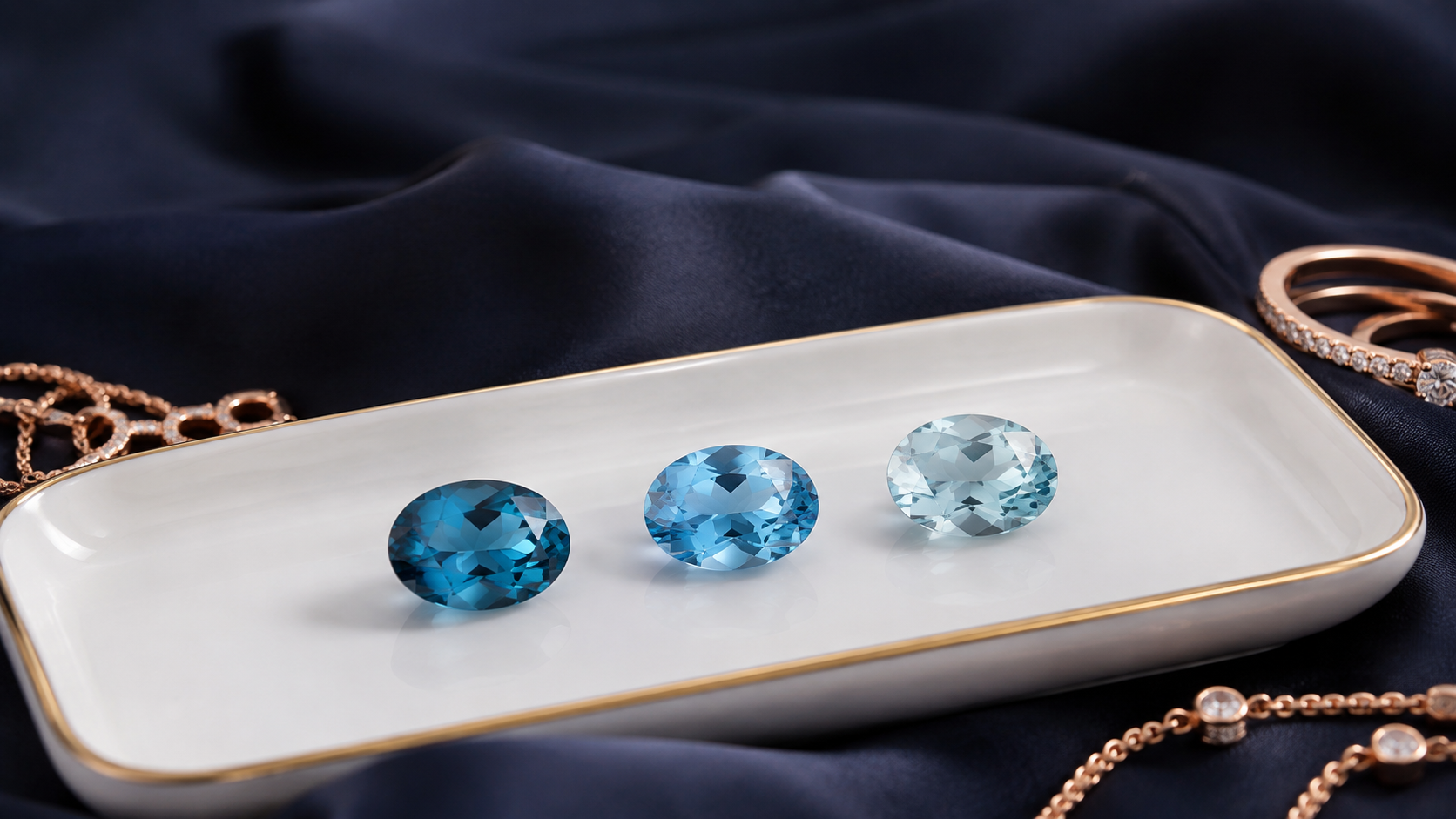
Blue topaz is one of the most widely sold coloured stones in the world, and one of the least understood. Clients arrive assuming it is either a cheap substitute for something better, or a rare natural blue. It is neither. It is a genuine natural mineral whose colour has almost always been produced by treatment, and the treatment is the reason it is affordable.
Where the blue comes from
Natural topaz is most often colourless. Blue crystals do occur in nature, but they are rare and generally a pale, watery tone that does not sell well.
The blue topaz in commercial jewellery starts as colourless material, usually from Brazil. It is exposed to radiation, which rearranges electrons in the crystal and creates colour centres, then heated to remove any unwanted brown and stabilise the blue. The result is a permanent colour that does not fade in light or with normal wear.
The trade names describe the depth of blue rather than any origin.
Sky blue. Pale and clear, the lightest of the three.
Swiss blue. A bright, saturated medium blue.
London blue. Deep, slightly inky, often with a greyish or teal cast. This grade needs the most intense treatment and is usually the most expensive of the three.
Is irradiated topaz safe to wear
This is the question people are quietly worried about. The honest answer is that treated blue topaz must be held in storage after irradiation until its residual radioactivity drops below regulatory limits before it is released for sale. In the United States that release is controlled by the Nuclear Regulatory Commission, and reputable suppliers in other markets follow equivalent practice. By the time a stone is set in a ring, it has been through that hold.
We buy from established cutters and dealers who can state the treatment history. If a supplier cannot tell you how a blue topaz was treated, that is a supplier to avoid.
What the treatment means for price
Colourless topaz is plentiful and the treatment is done at industrial scale. Supply is effectively unlimited, so a clean, well-cut blue topaz of several carats costs a fraction of what a similar sapphire or aquamarine would.
That is not a mark against the stone. It simply means you are paying for cutting and setting rather than rarity. Large stones become sensible in a way they are not with most other gems, which is why blue topaz suits bold cocktail rings and pendants.
The one weakness to respect
Mohs 8, with perfect cleavage. Topaz is hard enough to resist scratching well. But it has a plane along which it will split cleanly if struck the right way. A sharp knock to a faceted corner can cause a clean break.
That has two practical consequences. The cutter must orient the stone so the cleavage plane is not parallel to the table. And the setter must not overtighten prongs or use force when pressing a bezel. A good jeweller handles topaz with a little more patience than a sapphire.
For daily wear on a ring, a protective setting matters more than it would for corundum. In earrings and pendants the cleavage is rarely a concern.
Buying blue topaz well
Ask about treatment and expect a plain answer. Treated is normal. Undisclosed is not.
Judge the cut, not the carat. Since weight is cheap, the value is in a symmetrical, lively cut with no window through the centre.
Choose the tone for the metal. Sky and Swiss blue sit well in white gold. London blue is strong enough to hold its own in yellow gold, which is a combination rarely seen and worth considering.
Clean it gently. Warm soapy water and a soft brush. No ultrasonic for stones with inclusions, and no sudden heat.
Blue topaz is a stone for someone who wants clean, bright colour at a size that would otherwise be out of reach. Bought with its treatment understood and its cleavage respected, it is a reliable choice.
Book a complimentary design consultation at the C'Garden atelier, The MET Corporate Towers, Kuala Lumpur: 010-766 7448 · hq@cgarden.com.my
C'Garden is an independent bespoke jeweller in Kuala Lumpur. We are not affiliated with, endorsed by, sponsored by or certified by any organisation, laboratory or brand named in this article. Third-party names are used only to refer factually to those organisations and their published standards. All text and imagery in this article is original work created by C'Garden.
Reference
Gemological Institute of America. (n.d.). Topaz. GIA. https://www.gia.edu/topaz
All journal entries