
Baroque Pearls: Why Irregular Is Now Desirable
Baroque pearl jewellery has moved from the bargain tray to the front window. What baroque means, how it differs from keshi, how to judge and set one.
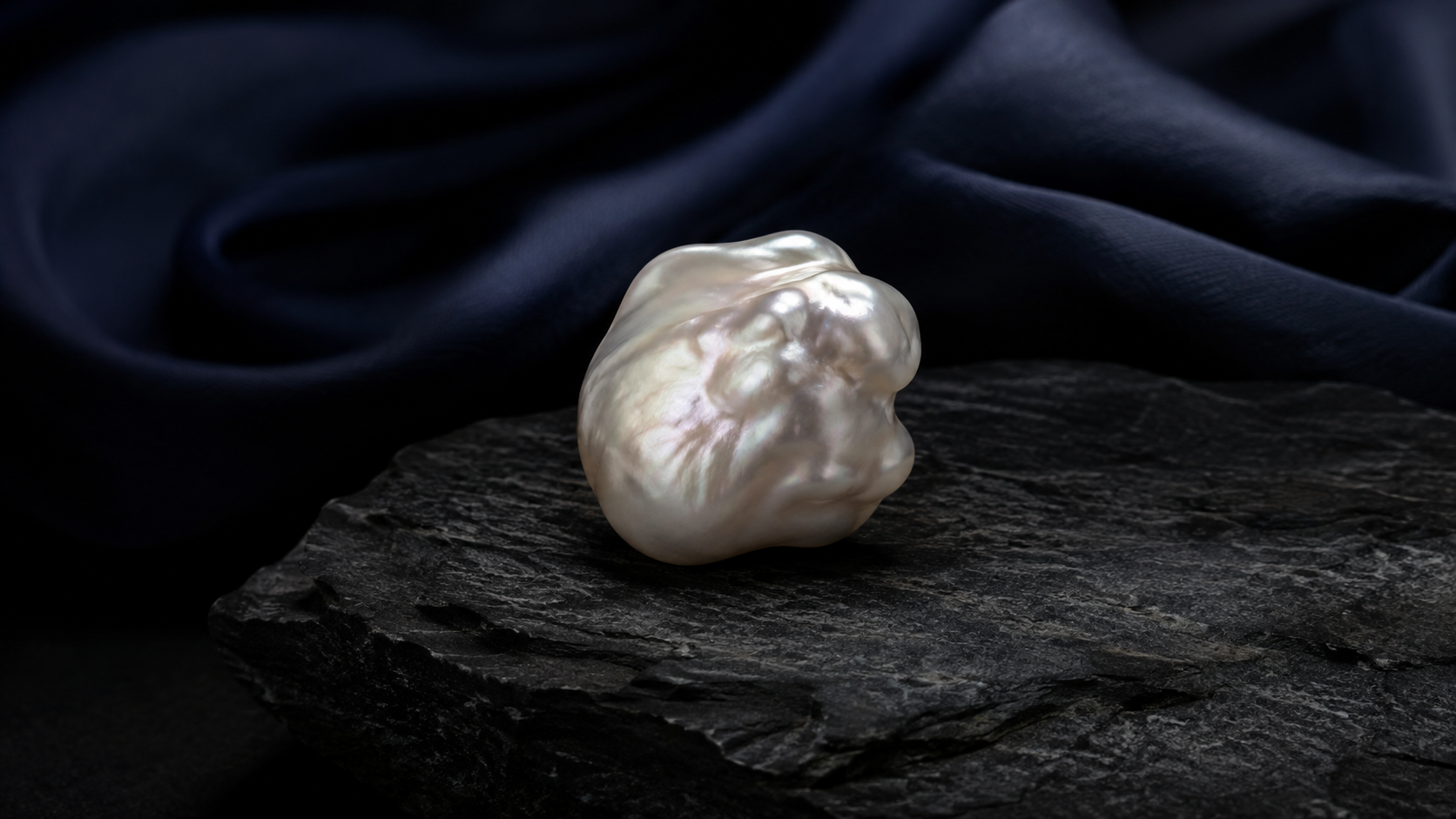
For most of the twentieth century a pearl that was not round was a pearl that had failed. It went into the cheaper tray or was sold by weight. That has changed, and baroque pearl jewellery now sits in the front window of serious houses. The pearls did not change. The taste did, and it helps to understand why before you buy.
What baroque means
Baroque is the trade term for any pearl that is noticeably irregular in shape. That covers a wide range: gently lumpy ovals, elongated drops with a twist, flattened discs, and wildly rippled forms with hollows and ridges. Semi-baroque describes a pearl that is off-round but still broadly symmetrical.
Irregularity happens for ordinary reasons. The nucleus shifts inside the mollusc, or the pearl sac grows unevenly, or nacre builds faster on one side. Freshwater pearls, which are usually grown without a bead nucleus, are baroque more often than not. South Sea and Tahitian baroques are the ones with the most presence, because they are large and the nacre is thick.
Baroque is not keshi
The two are often confused. A keshi pearl forms when the mollusc rejects the bead nucleus but the pearl sac continues to produce nacre. The result is a pearl made entirely of nacre, with no bead inside, often small and flattened, with intense lustre. Keshi pearls are almost always irregular, so every keshi is baroque, but most baroque pearls are not keshi. A seller who uses the words interchangeably is being loose.
Why the taste shifted
Round became ordinary. Cultured round pearls are now produced in very large numbers, and a uniform strand no longer signals rarity the way it once did.
Baroques suit modern design. A single irregular pearl on a plain chain, or one large baroque as a pendant, looks contemporary in a way a classic strand does not. Designers took to them, and clients followed.
No two are alike. A baroque piece cannot be reproduced. For a client commissioning something bespoke, that is a large part of the appeal.
Lustre is often exceptional. The folds and ridges of a baroque catch light from many angles, and the surface often shows more orient than a round pearl of the same origin.
How to judge a baroque pearl
The same factors as any pearl apply, with shape reinterpreted.
Lustre still comes first. A baroque with a dull surface has nothing to recommend it. Look for a sharp reflection across the high points.
Surface. Ridges and hollows are shape, not flaws. Pits, chalky patches and cracks are flaws.
Balance. The best baroques have a shape that reads as intentional: a drop with a graceful twist, a form with a clear front and back. Awkward, lumpy shapes with no natural orientation are harder to set and less pleasing to wear.
Nacre. Thick nacre is what gives a baroque its depth of lustre and its durability. This is where South Sea and Tahitian baroques earn their price over freshwater.
Matching, for pairs and strands. A pair of baroque earrings need not be identical, but they should be siblings in size, colour and character. A baroque strand should flow, with no single pearl shouting.
Setting an irregular shape
A baroque pearl dictates its own setting. The jeweller studies the pearl, finds the angle at which it hangs or sits best, and drills or caps it accordingly. Drop-shaped baroques suit pendants and earrings hung from a single point. Flatter forms can be set on a cap or in a bezel-style cup made to the pearl's outline. Very sculptural pearls are sometimes mounted with the metal following a ridge, so the setting becomes part of the form.
Because the pearl leads, a baroque piece is usually designed around the pearl rather than the other way round. That is the right order.
Care
Baroques need the same care as any pearl: on last, off first, wiped after wear, kept away from perfume, stored apart from harder pieces. The hollows can trap cosmetics, so a soft brush with a drop of mild soap and water, then a careful dry, keeps them clean.
Book a complimentary design consultation at the C'Garden atelier, The MET Corporate Towers, Kuala Lumpur: 010-766 7448 · hq@cgarden.com.my
C'Garden is an independent bespoke jeweller in Kuala Lumpur. We are not affiliated with, endorsed by, sponsored by or certified by any organisation, laboratory or brand named in this article. Third-party names are used only to refer factually to those organisations and their published standards. All text and imagery in this article is original work created by C'Garden.
Reference
Gemological Institute of America. (n.d.). Pearl. GIA. https://www.gia.edu/pearl
All journal entries