
Band Width: How 2mm and 4mm Feel and Look on the Hand
Wedding band width changes how a ring feels, how it wears and how it sits next to an engagement ring. A practical comparison of 2mm, 3mm and 4mm bands.
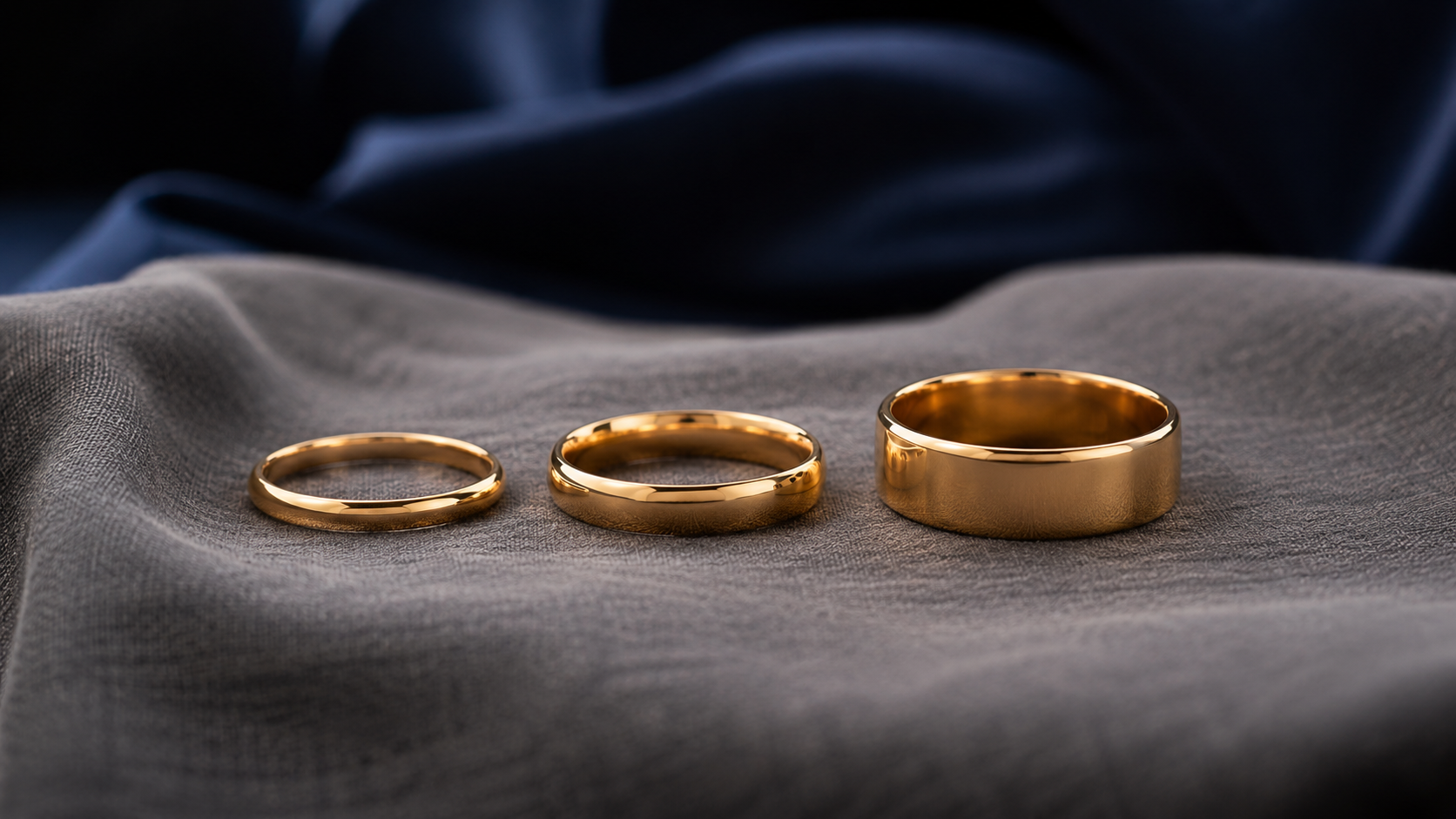
Wedding band width is the decision most couples make in about ten seconds, usually by pointing at a tray. It deserves a little longer. Two millimetres of difference changes how a ring feels on the finger, how it wears over decades, how it sits against an engagement ring, and how much gold you are paying for.
Nothing here is a rule. But there are consequences, and it is worth knowing them before the ring is made.
What the numbers mean
Width is measured across the band, from edge to edge, as it sits on the finger. A 2mm band is a fine line of metal. A 4mm band is roughly the width of a matchstick. Most women's bands fall between 1.8mm and 3mm; most men's between 4mm and 6mm. None of that is fixed, and plenty of people go the other way.
Thickness is a separate measurement: how deep the metal is from the inside of the ring to the outside. A wide band can still be thin, and a narrow band can be made substantial. Both numbers matter.
How a 2mm band feels
Almost nothing. A narrow band disappears on the hand within a day or two. There is very little metal between the fingers, so it never feels like it is in the way.
Sizing is forgiving. Narrow bands need less room to pass over the knuckle, and they tolerate the daily swelling and shrinking of fingers better than wide ones. In KL humidity, that matters.
It sits neatly against an engagement ring. If the engagement ring has a low setting, a 2mm band usually tucks in without a gap.
The trade-off is longevity. A narrow band starts with less metal, and every year of wear removes a little. Thin bands are the ones that eventually go out of round or crack at the base. A 2mm band made at least 1.6mm thick ages far better than one made at 1.2mm.
How a 4mm band feels
You know it is there. For the first week or two, a 4mm band feels like a presence between the fingers. Most people stop noticing within a month. Some never quite do, especially on a short finger.
Size up slightly. Wide bands cover more of the finger and have less room to move, so they feel tighter than a narrow band of the same nominal size. Jewellers typically go up a quarter to a half size for anything over 4mm. A comfort-fit interior, with a rounded inside edge, helps considerably.
It wears very well. More metal means more years before anything needs attention. A 4mm band at a sensible thickness will outlast its owner without intervention.
It costs more. The gold content roughly doubles between 2mm and 4mm at the same thickness. In 916 or 750 gold, that difference is visible on the invoice.
The middle option
A 3mm band is the answer for a lot of people who cannot decide. It has enough metal to last, enough presence to read as a wedding ring, and it still sits neatly beside most engagement rings. It is the width we make most often for women, and the one that causes the fewest second thoughts.
Matching to the hand
Long, slim fingers carry width easily. A 4mm or even 5mm band looks proportionate.
Short fingers are usually better served by narrower bands, which leave more finger visible and do not foreshorten the hand.
Large knuckles favour narrower bands, because the ring has to pass the knuckle and then sit on a smaller section of finger below it. Wide bands tend to spin.
Try the width before the metal
Most workshops keep plain test bands in a range of widths. Wear a 2mm and a 4mm for a few minutes each, make a fist, type, pick up a cup. The right width tends to announce itself. Decide that first, then decide on the gold.
Book a complimentary design consultation at the C'Garden atelier, The MET Corporate Towers, Kuala Lumpur: 010-766 7448 · hq@cgarden.com.my
C'Garden is an independent bespoke jeweller in Kuala Lumpur. We are not affiliated with, endorsed by, sponsored by or certified by any organisation, laboratory or brand named in this article. Third-party names are used only to refer factually to those organisations and their published standards. All text and imagery in this article is original work created by C'Garden.
Reference
Jewelers of America. (n.d.). Buying jewelry. Jewelers of America. https://www.jewelers.org/buying-jewelry
All journal entries