
Aquamarine and Morganite: The Gentle Beryls
An aquamarine ring and a morganite ring are the same mineral in two colours. How the beryls compare on colour, clarity, hardness and value, and daily wear.
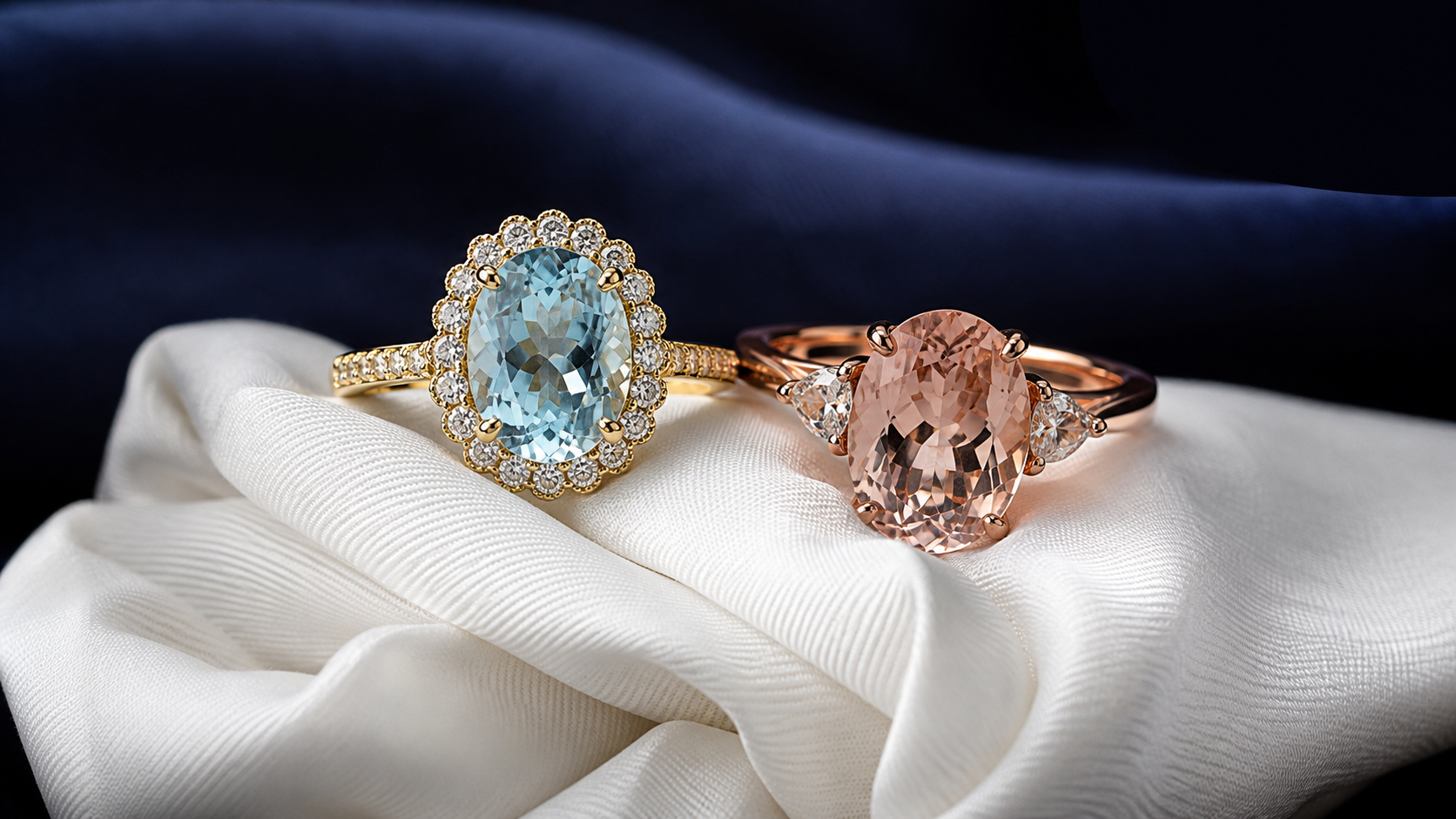
Emerald gets the attention, but the beryl family has two quieter members that make better daily-wear stones than their famous relative. An aquamarine ring and a morganite ring are the same mineral, beryllium aluminium silicate, coloured by different trace elements. Both are typically cleaner than emerald, both are tougher, and both come in the pale, soft tones that suit large stones and light settings.
What they share
Hardness. 7.5 to 8 on the Mohs scale. Comfortably wearable in rings, though they will pick up fine scratches over years and should not be stored loose against sapphire or diamond.
Clarity. Unlike emerald, which is expected to carry inclusions, aquamarine and morganite are usually eye-clean. An included stone is a lesser stone, not a normal one.
Size. Both form in large crystals, so stones of five, ten or twenty carats are available and affordable. Pale colours need size to show; a small stone of either can look like glass.
Treatment. Both are commonly heated to improve colour. Aquamarine is heated to remove green and leave a purer blue. Morganite is heated to remove yellow and leave pink or peach. Both treatments are stable and widely accepted, and should be disclosed.
Aquamarine
Coloured by iron, aquamarine ranges from a barely-there blue through to a medium sea blue. The deepest colours are the most valued and come mostly from Brazil, with fine material also from Africa.
What to look for. As much saturation as the budget allows, with no grey. Most aquamarine is pale; a stone with real colour stands out immediately beside its neighbours.
Aquamarine versus blue topaz. The two are often confused. Blue topaz is almost always irradiated and heated to reach its colour, is much cheaper, and tends toward a stronger, slightly electric blue. Aquamarine's blue is softer and, in fine stones, more valuable. A jeweller can separate them with a refractometer.
Cut. Aquamarine is often cut in emerald and long cushion shapes, which suit its clean crystal and keep the colour concentrated.
Morganite
Coloured by manganese, morganite runs from pale pink through peach to a warm salmon. It became popular for engagement rings during the past fifteen years as a softer alternative to diamond, and rose gold settings became its default partner.
What to look for. A clear pink or peach without brown. The colour is usually pale, so the same size rule applies.
Colour stability. Some morganite fades slightly with long exposure to strong light. It is not dramatic, but a morganite ring worn outdoors every day in Malaysian sun for decades may soften in tone.
The engagement ring question. Morganite is hard enough for daily wear, but it is not diamond. Over many years the facets will soften and the stone will need repolishing. Buyers who accept this get a large, pretty stone for a modest sum. Buyers who expect diamond-like permanence are better served elsewhere.
Setting the beryls
Bezel or half-bezel settings protect edges on rings and suit the clean, geometric cuts these stones take well.
White metals make aquamarine read cooler and cleaner. Yellow gold warms it and can make pale stones look greenish.
Rose gold flatters morganite, though the match is so common that some buyers now choose white or yellow to avoid it.
Care in a humid climate
Neither stone is affected by humidity. Both can be cleaned in warm soapy water with a soft brush. Ultrasonic cleaning is generally safe for untreated or heated stones without fractures, but a stone with visible inclusions should be cleaned by hand.
Which one
Aquamarine holds value better and has a longer history in fine jewellery. Morganite is warmer, currently more fashionable, and usually cheaper for the size. Both are honest, gentle stones that look far more expensive than they are when cut well and set with care.
Book a complimentary design consultation at the C'Garden atelier, The MET Corporate Towers, Kuala Lumpur: 010-766 7448 · hq@cgarden.com.my
C'Garden is an independent bespoke jeweller in Kuala Lumpur. We are not affiliated with, endorsed by, sponsored by or certified by any organisation, laboratory or brand named in this article. Third-party names are used only to refer factually to those organisations and their published standards. All text and imagery in this article is original work created by C'Garden.
Reference
Gemological Institute of America. (n.d.). Aquamarine. GIA. https://www.gia.edu/aquamarine
Gemological Institute of America. (n.d.). Morganite. GIA. https://www.gia.edu/morganite
All journal entries