
Amethyst and Citrine: Good Colour Without the Price
Amethyst jewellery and citrine offer strong, clean colour at modest prices. What both quartzes are, how citrine is usually made, and how to buy them well.
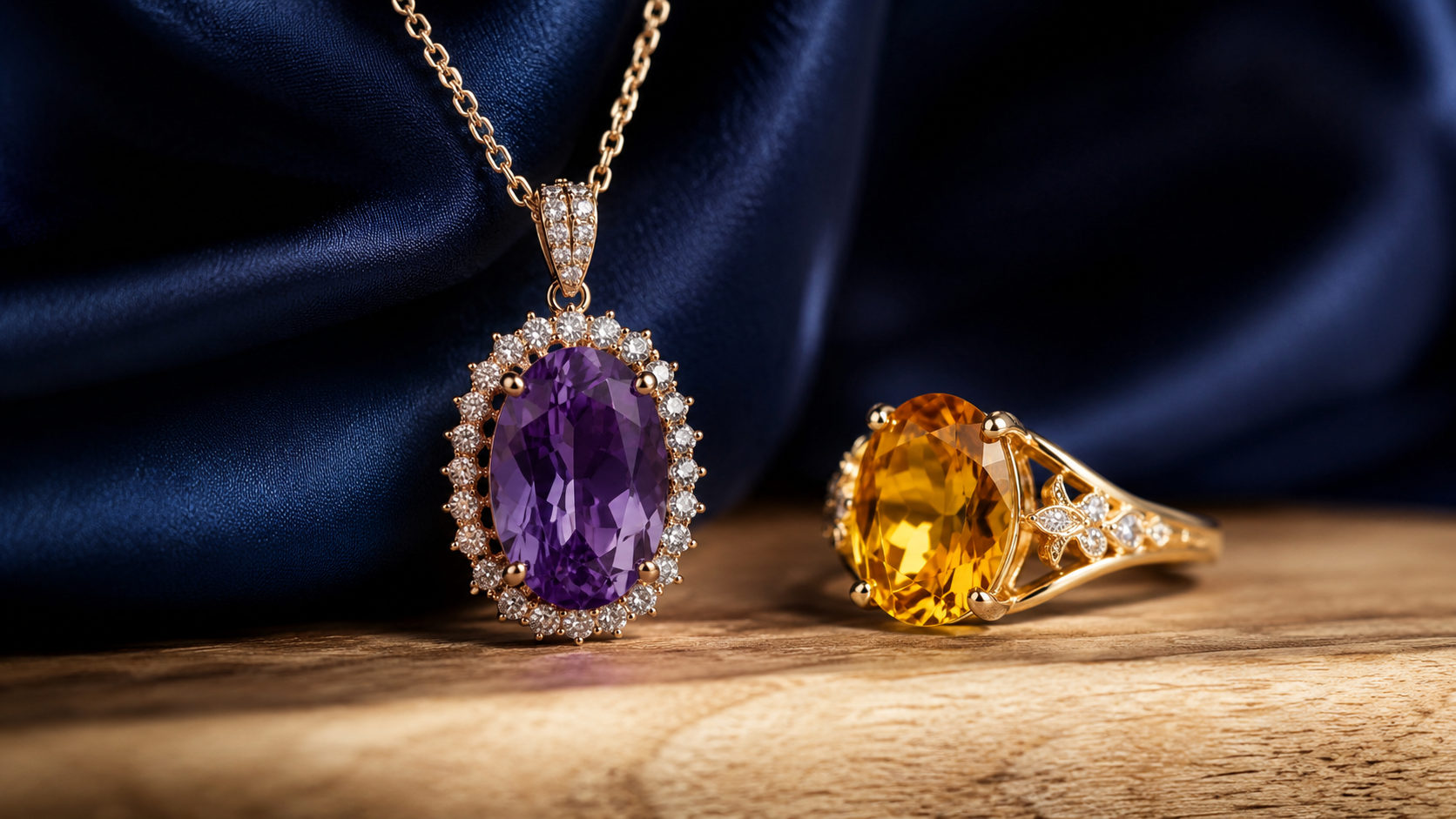
For centuries amethyst was ranked with ruby and sapphire, worn by bishops and royalty and priced accordingly. Then large deposits were found in Brazil in the nineteenth century, and the stone became abundant. Amethyst jewellery today offers what few other stones can: a saturated, distinctive colour in large sizes at prices that leave room for good metal and good workmanship.
Citrine, its yellow sibling, tells a similar story with a twist.
What they are
Both are quartz, silicon dioxide, the same mineral as rock crystal. The purple of amethyst comes from iron and natural irradiation within the earth. The yellow to orange of citrine also comes from iron, in a different state.
Hardness. 7 on the Mohs scale. Adequate for rings, though quartz scratches more readily than the harder stones and will show wear on the facet edges after years of daily use.
Clarity. Both are expected to be eye-clean. Included material is cut into beads or carved, not faceted for fine jewellery.
Size. Large clean crystals are common. Ten and twenty carat stones are affordable, which makes both quartzes ideal for statement pendants and cocktail rings.
Amethyst
Colour. From pale lilac to a deep purple with red flashes. The most valued is a strong, even purple with red or blue highlights and no brownish zones. Very pale material, sometimes called "rose de France", is inexpensive and has its own quiet charm.
Colour zoning. Amethyst often shows bands of lighter and darker purple. A good cutter orients the stone so the deepest colour sits at the base and the whole stone reads evenly from the top.
Fading. Prolonged strong sunlight can lighten amethyst over years. A ring worn daily outdoors will hold up for a long time, but a display piece left in a sunny window will not.
Heat. Heating amethyst turns it yellow, which brings us to citrine.
Citrine
The honest story. Natural citrine is uncommon. The overwhelming majority of citrine sold is amethyst or smoky quartz that has been heated to produce yellow, orange or the reddish orange sometimes called "Madeira". The result is stable, permanent and indistinguishable from natural citrine to most buyers.
This is not a scandal. It is a long-established, disclosed practice. Ask, and a reputable seller will tell you. Natural pale yellow citrine, when found, is prized by collectors more for its rarity than its looks.
Colour. Pale lemon through to deep orange-brown. The mid-tone golden oranges are the most popular for jewellery. Very dark reddish stones can look dull in a ring.
In settings. Citrine suits yellow gold naturally, and the combination is warm without being loud. In white metal it reads cooler and more modern.
Ametrine
A single crystal with amethyst purple and citrine yellow in separate zones, mined mostly in Bolivia. Cut to show the boundary, it makes an unusual centre stone. Cut as a rectangular step, the two colours sit side by side. Also heat-treatable, and the same disclosure questions apply.
Buying either quartz
Prioritise colour. Since size and clarity come cheaply, the money should go into saturation and evenness.
Check the cut. A poorly cut quartz with a large window through the middle loses most of its colour. Look down into the stone from the top; you should see colour, not the setting behind it.
Pay for the setting. A fine amethyst in 750 gold with a proper gallery costs modestly more than the same stone in a thin mass-produced mount and will last decades longer.
Do not overpay for the name. A big, beautiful amethyst is still an amethyst. The pleasure is in the colour; the price should reflect the stone, not the marketing.
Book a complimentary design consultation at the C'Garden atelier, The MET Corporate Towers, Kuala Lumpur: 010-766 7448 · hq@cgarden.com.my
C'Garden is an independent bespoke jeweller in Kuala Lumpur. We are not affiliated with, endorsed by, sponsored by or certified by any organisation, laboratory or brand named in this article. Third-party names are used only to refer factually to those organisations and their published standards. All text and imagery in this article is original work created by C'Garden.
Reference
Gemological Institute of America. (n.d.). Amethyst. GIA. https://www.gia.edu/amethyst
Gemological Institute of America. (n.d.). Citrine. GIA. https://www.gia.edu/citrine
All journal entries