
Alexandrite: The Stone That Changes Colour
The alexandrite gemstone shows green by day and red under lamplight. Why it changes, why fine stones are rare, how synthetics differ, and what to check.
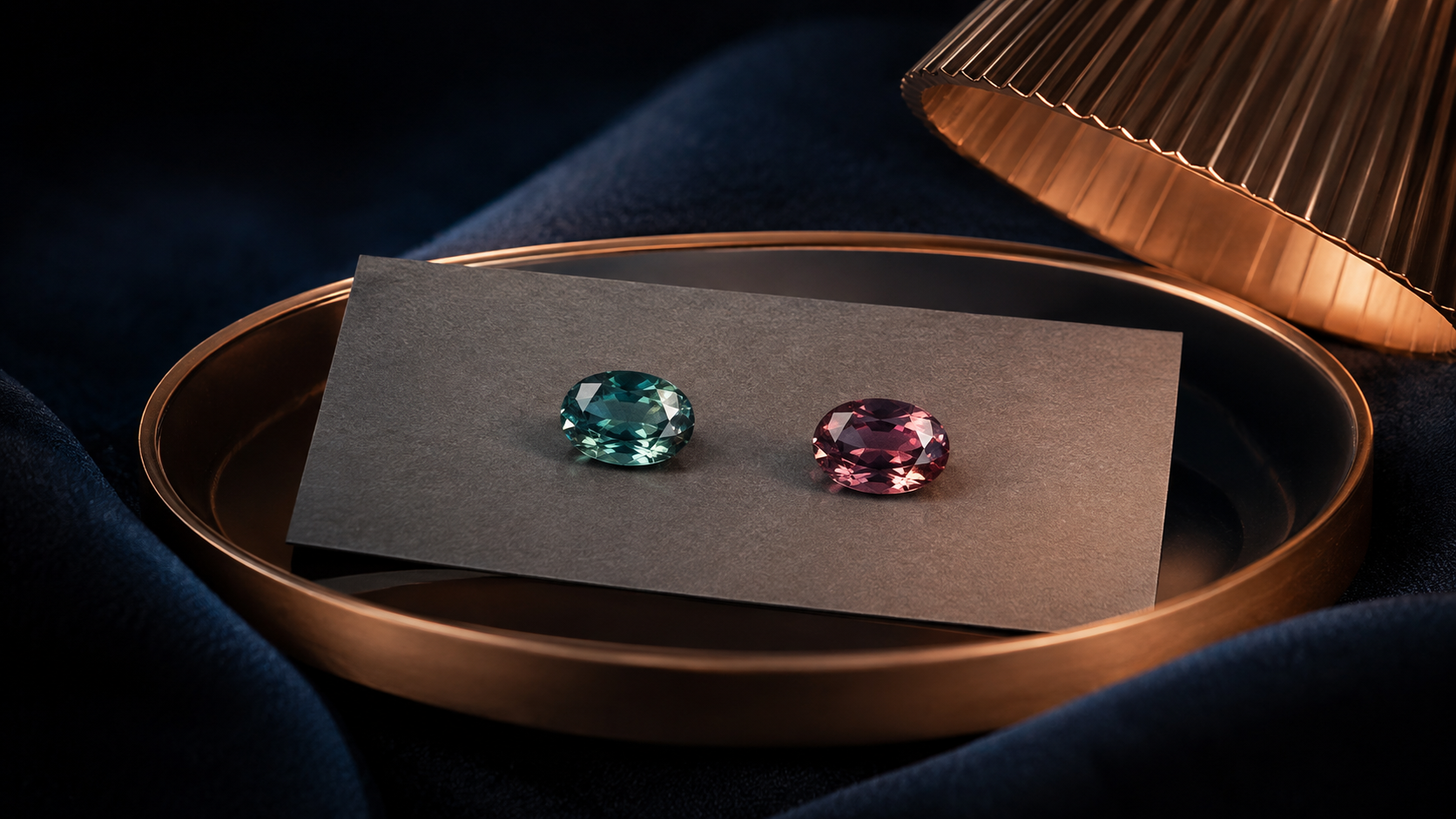
Hold a fine alexandrite gemstone at a window and it is green, somewhere between leaf and teal. Carry it to a lamp and it turns red, purplish red or raspberry. Nothing has been done to it. The stone is the same; the light is different. This is the most dramatic example of a phenomenon called colour change, and alexandrite is its defining stone.
What alexandrite is
Alexandrite is the colour-change variety of chrysoberyl, a beryllium aluminium oxide. Ordinary chrysoberyl is yellow to greenish and inexpensive. Add a trace of chromium in the right crystal environment and the stone absorbs light in a way that leaves it balanced between green and red. Daylight, rich in blue and green wavelengths, tips it green. Incandescent light, rich in red, tips it red.
Hardness. 8.5 on the Mohs scale, harder than any stone except corundum and diamond. Excellent for daily wear.
Toughness. Good. No cleavage concerns of the kind that affect tanzanite or topaz.
Treatment. Essentially none. Alexandrite is sold as found.
Why it is rare
The chemistry requires beryllium and chromium to be present together, and geologically they are usually found apart. The first significant deposit, in Russia's Ural Mountains in the 1830s, produced the stones that made the name, and was largely worked out within a century. Later finds in Sri Lanka, Brazil and East Africa keep the market supplied, but fine stones with a strong, clean change in sizes above a carat or two remain genuinely scarce.
Judging the change
Strength of change. The most important factor. A stone that goes from a clear green to a clear red is exceptional. Most alexandrite shows a partial shift, often from greyish green to brownish or purplish red. Dealers describe the change as a percentage; a reputable laboratory report will describe it in words.
Quality of each colour. A strong change between two muddy colours is less valuable than a moderate change between two attractive ones.
Clarity. Alexandrite is often included. Clean stones are prized, but a slight inclusion is preferred over a poor colour change.
Size. Stones above three carats with a fine change are rare enough that prices climb steeply.
Synthetic alexandrite
Synthetic alexandrite has been made since the 1970s and shows a genuine colour change, sometimes stronger and cleaner than natural material. It is chemically real chrysoberyl and is not a fake in the sense of glass. It is, however, worth a small fraction of natural stone.
Synthetic corundum or spinel with colour change is also sold, sometimes misleadingly as "alexandrite". These are not chrysoberyl at all and show a bluish to purplish shift rather than green to red.
For any alexandrite of consequence, a report from a recognised laboratory stating "natural" is essential. Laboratories separate synthetic from natural reliably through inclusion study and chemical analysis.
Alexandrite in jewellery
Rings. Ideal. The hardness allows fine prong settings and daily wear, and a ring moves between lighting environments constantly, which is where the stone performs.
Metal. White metals show both colours neutrally. Yellow gold warms the red and can dull the green. A common compromise is a white gold or platinum head on a yellow shank.
Lighting at home. Under many LED bulbs alexandrite shows a muted, intermediate colour. A stone that seems disappointing indoors may simply need a warmer lamp.
Buying one
Look at the stone in daylight and under an incandescent or warm halogen lamp, not under fluorescent or cool LED light, before deciding. Confirm natural origin with a report. Expect to pay significantly for a strong change, and to have a wide choice of pleasant, affordable stones with a subtle one. Both are alexandrite, and both do the trick that no other stone does quite so well.
Book a complimentary design consultation at the C'Garden atelier, The MET Corporate Towers, Kuala Lumpur: 010-766 7448 · hq@cgarden.com.my
C'Garden is an independent bespoke jeweller in Kuala Lumpur. We are not affiliated with, endorsed by, sponsored by or certified by any organisation, laboratory or brand named in this article. Third-party names are used only to refer factually to those organisations and their published standards. All text and imagery in this article is original work created by C'Garden.
Reference
Gemological Institute of America. (n.d.). Alexandrite. GIA. https://www.gia.edu/alexandrite
All journal entries