
Adding Stones to an Existing Ring
You can add diamonds to ring shanks, shoulders and bands, within limits set by the metal and the existing design. What is feasible and how it is done.
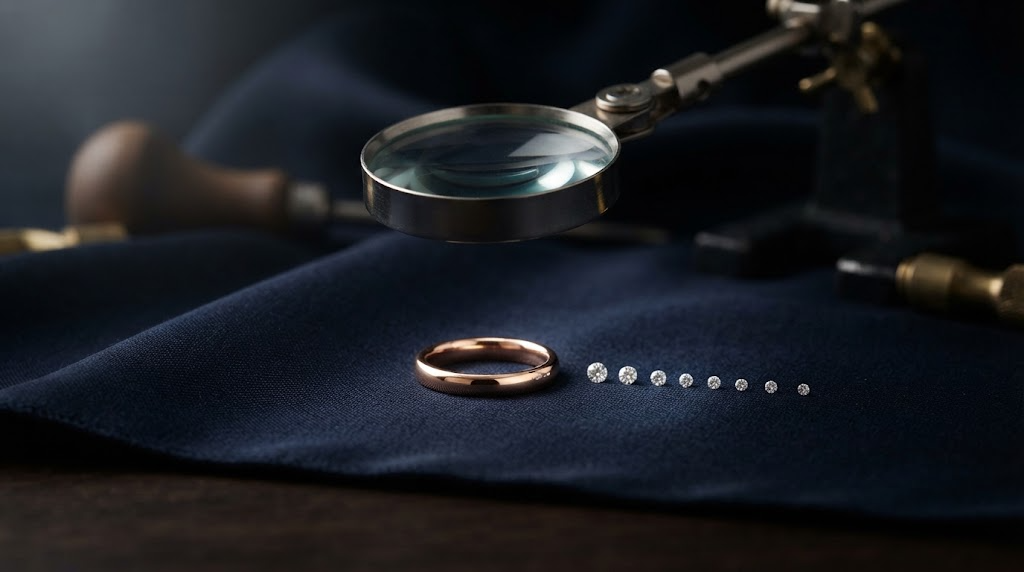
A plain ring can become a set ring. People ask whether a workshop can add diamonds to ring shoulders that were made plain, put a row of stones into a wedding band, or surround an existing solitaire with a halo. The answer is usually yes, with conditions, and the conditions come from the metal and the geometry of the piece rather than from the stones.
This is what decides whether it can be done well.
What the ring has to offer
Metal depth. To set a stone, the workshop cuts a seat into the metal and raises or shapes something to hold it. That needs thickness. A 1.5mm band cannot take a 2mm stone without being pierced through. As a rough guide, the metal should be at least half a millimetre deeper than the stone at the seat.
Metal width. The stone plus its holding metal has to fit across the band. A 2mm band takes stones of about 1.2mm; a 3mm band takes stones up to about 2mm comfortably.
Alloy. 750 gold and platinum hold small stones well. 916 gold is soft, and while stones can be set into it, the beads or prongs holding them wear faster. Very small stones in 916 are a long-term maintenance commitment.
Condition. A worn, thinned band cannot be set. It may need to be rebuilt first, or replaced with a new shank that is then set.
The common additions
Stones down the shoulders. The most requested upgrade to a plain solitaire. The shoulders are cut and stones set in a channel, in beads or in shared prongs. This works on most rings with a reasonable shank.
A row across a wedding band. Turning a plain band into a half eternity. Feasible if the band is wide and deep enough. On thin bands the better answer is a new band.
A halo around the centre stone. This is not really an addition; it is a new head. The centre stone is unset, a new halo head is made, and the stone is reset into it on the old shank. A significant project, and often the point at which a new ring makes more sense.
Flush-set accents. Single small stones set flat into the surface of a band, scattered or at intervals. The least demanding addition, and the most robust, because the stone sits below the metal surface.
A stone in a men's band. A single flush-set diamond or sapphire in a wide plain band. Very common, quick to do.
How it is done
The ring is cleaned and inspected. The setter marks the positions, drills or burrs seats to the exact stone size, and sets each stone by hand. Bead setting raises small curls of metal over the stone's edge; channel setting folds a wall over; flush setting burnishes the metal rim down around it. The ring is then refinished, which usually means polishing the whole surface, so any engraving or textured finish will need to be redone.
What it cannot do
Make a thin ring thick. If the metal is not there, stones cannot be held in it.
Match an old alloy exactly. If new metal has to be added, there may be a very slight colour difference. On white gold it is hidden by plating; on yellow and rose it is usually invisible but not always.
Keep the ring unchanged. Adding stones means cutting into the piece. If the ring has sentimental value in its current form, consider whether you want it altered at all, or whether the better path is a new ring that references it.
A practical suggestion
Bring the ring in before deciding anything. Ten minutes under magnification tells a jeweller whether the metal can take stones, how many, and what size. That conversation decides the design, not the other way round.
Book a complimentary design consultation at the C'Garden atelier, The MET Corporate Towers, Kuala Lumpur: 010-766 7448 · hq@cgarden.com.my
C'Garden is an independent bespoke jeweller in Kuala Lumpur. We are not affiliated with, endorsed by, sponsored by or certified by any organisation, laboratory or brand named in this article. Third-party names are used only to refer factually to those organisations and their published standards. All text and imagery in this article is original work created by C'Garden.
Reference
Jewelers of America. (n.d.). Jewelry repair and care. Jewelers of America. https://www.jewelers.org/buying-jewelry/jewelry-repair-and-care
Gemological Institute of America. (n.d.). Jewelry design and manufacturing. GIA. https://www.gia.edu/jewelry-design
All journal entries