
916 Gold vs 999 Gold: Which One Belongs on Your Wrist?
916 gold vs 999 gold explained by a Kuala Lumpur bespoke jeweller. Purity, durability, price and which gold actually belongs on a wrist you wear every day.
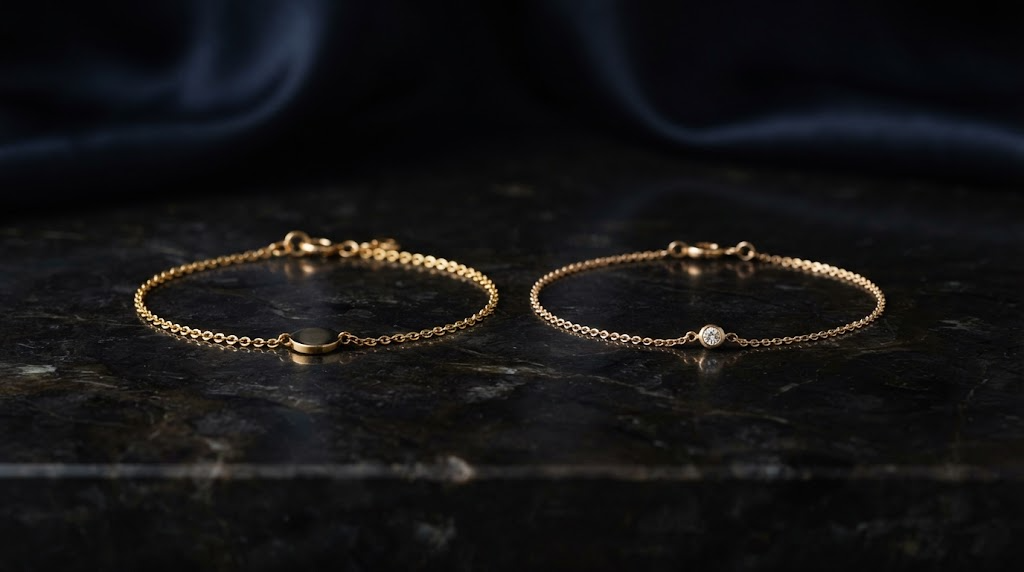
Walk into any goldsmith in Kuala Lumpur, along Jalan Masjid India, through the jewellery floor at any major mall, or into a small family shop in Klang, and you will be asked one question before any other.
916 or 999?
It sounds like a technical question about metallurgy. It is really a question about how you intend to live with the piece. And in our experience at the atelier, most people answer it backwards, because they are comparing the wrong things.
This guide explains what 916 gold and 999 gold actually are, how each behaves over years of wear, what the price difference really represents, and how we decide between them when we design a piece for a client.
What 916 gold and 999 gold actually mean
The numbers are fractions expressed per thousand.
916 gold contains 91.6% pure gold. The remaining 8.4% is other metal, typically copper, silver, zinc or a combination. In the karat system this is 22K gold. It is the standard for wearable gold jewellery across Malaysia, Singapore, India and much of Southeast Asia.
999 gold contains 99.9% pure gold. Almost nothing else. This is 24K gold, the highest purity in ordinary commercial circulation, and the international benchmark for investment-grade metal.
There is also 750 gold, which is 75% pure, or 18K. You will see this more often in European settings and in pieces where a harder, more scratch-resistant metal is needed to hold gemstones securely.
So far, so simple. The interesting part is what those percentages do.
Why the 8.4% matters more than you think
That small fraction of other metal in 916 gold is not a dilution. It is a structural decision.
Pure gold is remarkably soft. It is one of the most malleable metals known, a single gram can be beaten into a sheet nearly a square metre in area. That property is wonderful for gold leaf and disastrous for a clasp.
Alloying gold gives it a spine. It allows the metal to:
- Hold a clasp closed through several hundred openings a year
- Keep a link from stretching under the weight of the piece
- Let a woven band stay flat after a decade of being pushed up a sleeve
- Take and hold a polish
- Resist the small dents that daily life delivers constantly
999 gold has none of this reinforcement. It is warmer in colour, noticeably deeper and richer to the eye, unmistakably precious, and soft enough to mark with a fingernail. It bends. It scratches. It slowly loses its shape.
Left in a safe, it is perfect. Worn daily on a wrist, it is a slow tragedy.
The colour difference is real
This is the part nobody explains properly.
999 gold is visibly more yellow. Placed beside a 916 piece, the difference is obvious even to an untrained eye, deeper, more saturated, almost orange in warm light. This is pure gold's natural colour, undiluted.
916 gold is slightly paler and, depending on the alloy used, may lean warm or cool. A copper-heavy alloy pulls toward rose. A silver-heavy alloy pulls toward a lighter, cooler yellow.
Many buyers who think they prefer 999 actually prefer that deeper colour, not the purity. It is worth knowing that colour and durability are separable, you can choose a 916 alloy that reads warm without accepting the softness of pure gold.
Price: what you are actually paying for
The price of any gold piece has two components, and they behave completely differently.
The metal cost. Weight multiplied by purity multiplied by the current gold price. This part is close to arithmetic. 999 gold costs more per gram than 916, simply because there is more gold in each gram.
The making charge. What is charged for design, fabrication, setting, finishing and the jeweller's skill. This has nothing to do with purity and everything to do with what was done to the metal.
Here is what buyers often miss: an intricate 916 gold bracelet can cost more than a plain 999 chain of the same weight, and this is not a markup, it reflects hours of work that the plain piece did not require.
When you compare two prices, ask for both figures separately. Any reputable jeweller in Kuala Lumpur will give you the gram weight and the making charge without hesitating.
How we decide, in practice
At C'Garden we build to the life the piece will lead.
Bracelets are 916. A bracelet leads the hardest life of any piece of jewellery. It is on the wrist that meets the desk edge, the car door, the handbag strap, the steering wheel. Our flat woven band, thousands of fine wires worked into a flat strap, would lose its shape within a year in 999. In 916 it holds.
Rings are 916 or 750, depending on the setting. Where a stone must be gripped by prongs, we often prefer a harder alloy, because a prong in soft metal will splay over time and eventually release the stone.
999 appears where gold is meant to be a blessing rather than a structure. Gold foil on a charm, an accent that sits protected. There, purity is the entire point. Nothing is asked of the metal except to mean something.
The question underneath the question
Most people asking about 916 vs 999 gold in Malaysia are really asking a different question: am I buying jewellery, or am I buying gold?
Both are completely legitimate. They are simply not the same purchase, and one object rarely does both jobs well.
If the piece is meant to be worn, to become the thing you reach for without thinking, the bracelet you forget you are wearing until someone compliments it, buy 916 and wear it hard. It will survive you.
If the piece is meant to hold value quietly, 999 is the honest answer, and it does not need to be a bracelet to do that job. Investment gold is bought for the metal, sold close to spot, and does not require workmanship you will pay for and never see.
Many Malaysian households sensibly own both. 999 gold for investment, 916 gold for wearing. That is not indecision. That is understanding that the two purchases have different purposes.
Frequently asked questions
Is 916 gold real gold?
Yes. 916 gold is 91.6% pure gold. The alloy content is what makes it durable enough to wear.
Which is better for resale, 916 or 999?
999 gold is closer to the investment standard and generally commands a price nearer to spot. But resale value on any jewellery piece is based on metal content, not on what you paid for the workmanship, which is true of both.
Can 999 gold be worn every day?
It can, but it will show it. Expect scratches, softening of detail and gradual distortion. For daily wear we would steer you to 916 every time.
Does 916 gold fade or tarnish?
No. Gold does not tarnish. What dulls a piece is surface buildup, hand cream, sunscreen, soap residue, and that cleans off with warm water and mild soap.
What does the stamp inside my bracelet mean?
It is the purity mark. 916 means 91.6% gold. Check that the stamp matches your invoice before you pay.
What we would tell you across the table
We would rather you left the atelier with the right piece than the more expensive one.
If you are choosing a bracelet you will wear to work, to dinner, on holiday and to your daughter's wedding, choose 916 gold, choose the design you keep looking at, and stop thinking about the metal.
If you are setting money aside, buy the metal in the most efficient form available and let it do that job properly.
Most disappointment in this trade comes from asking one object to be two things at once.
Book a complimentary design consultation at the C'Garden atelier, The MET Corporate Towers, Kuala Lumpur: 010-766 7448 · hq@cgarden.com.my
C'Garden is an independent bespoke jeweller in Kuala Lumpur. We are not affiliated with, endorsed by, sponsored by or certified by any organisation, laboratory or brand named in this article. Third-party names are used only to refer factually to those organisations and their published standards. All text and imagery in this article is original work created by C'Garden.
Reference
World Gold Council. (n.d.). Gold jewellery: Colour, carat & purity. World Gold Council. https://www.gold.org/about-gold/about-gold-jewellery
All journal entries