
22k vs 24k Gold: Which Should You Buy?
22k vs 24k gold is a choice between wearing and holding. How the two behave on the body, how each is priced, and which suits a bangle, a chain or a bar.
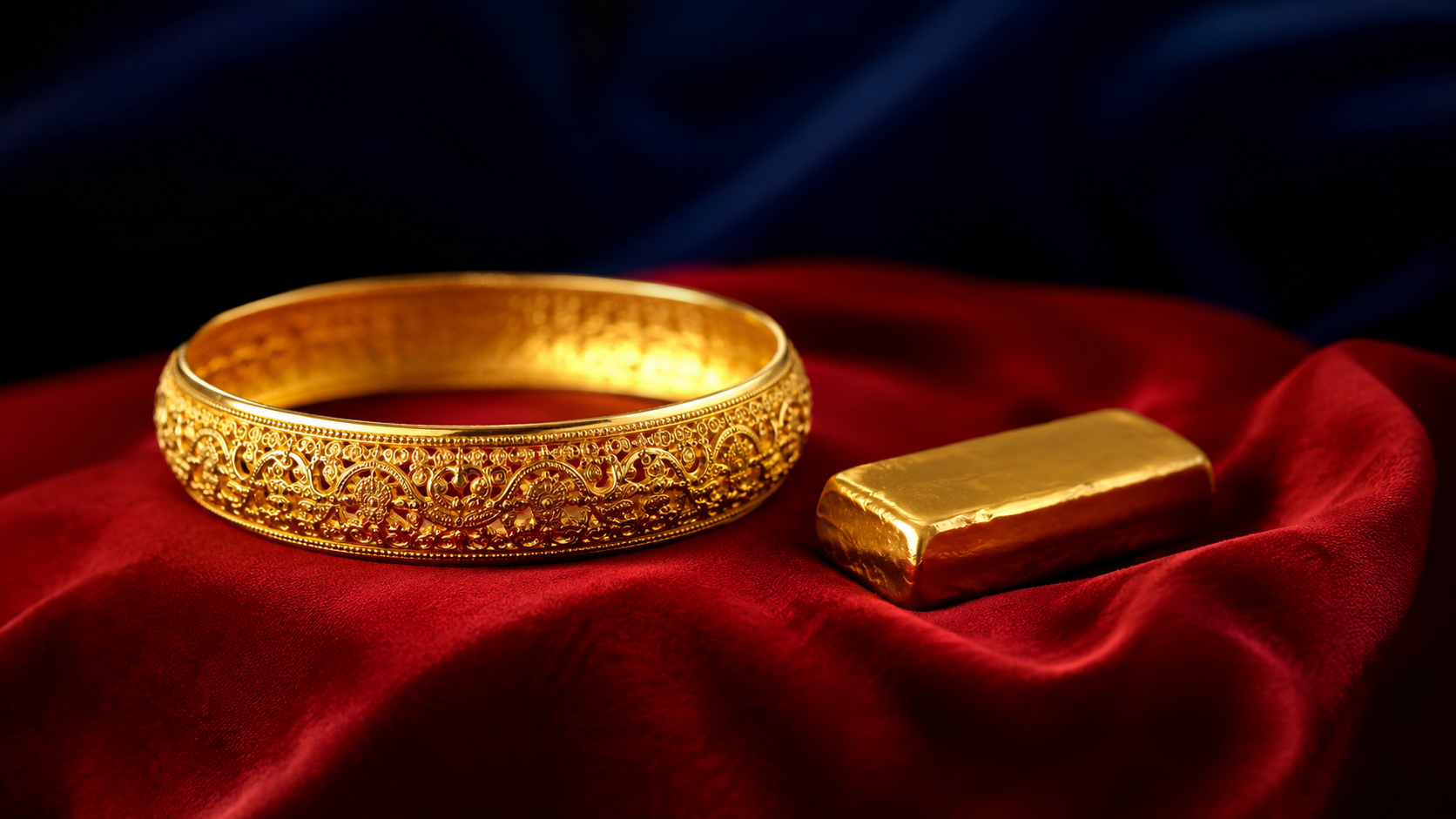
The 22k vs 24k gold question comes up at every goldsmith's counter in Malaysia, where the price board shows both 916 and 999 by the gram. The two are close in purity and far apart in behaviour. Which to buy depends almost entirely on whether the gold is going to be worn or kept.
What the numbers mean
Twenty-four karat gold is as pure as it is practical to refine, marked 999 or 999.9. Twenty-two karat is 916, meaning 91.6 percent gold with the balance in copper and silver. The difference is a little over eight percent by weight, and that small alloy addition is what gives 916 enough strength to be worn.
How each behaves
Colour. 24k has the deepest, most saturated yellow of any gold. 22k is only slightly less rich, and the two are hard to separate by eye on a shop tray.
Hardness. Pure gold is about 2.5 on the Mohs scale, softer than a fingernail. It dents, scratches and deforms with ordinary handling. 22k is harder, though still soft compared with 18k. A 24k ring will go out of round within weeks. A 22k ring lasts years if it is heavy enough and worn sensibly.
Workability. Because it is so soft, 24k jewellery is generally made in simple, chunky forms, or in intricate but purely decorative pieces that are not meant for daily wear. 22k can be drawn into chain, hammered, textured and made into bangles that survive real life. Neither is suitable for holding stones in prongs.
Tarnish. Pure gold does not react with air or skin. 22k, with its small copper content, can very occasionally show slight dulling in sweat and humidity, which polishing removes. In practice both stay bright.
How each is priced
Gold in Malaysia is sold at the day's rate per gram for the given purity, plus a charge for workmanship. The metal price tracks the world gold price; the workmanship charge depends on the shop and the complexity of the piece.
For 999, most of what you pay is metal. Bars, coins and simple pieces carry a small workmanship margin. For 916 jewellery, the workmanship charge on an intricate piece can be a meaningful share of the total, and that share is not recovered when the piece is sold back.
Buy-back is by weight and purity, at the day's rate, less a margin. The closer a piece is to pure metal with minimal workmanship, the smaller the gap between what you paid and what you get back.
22k vs 24k gold: which to buy
For holding value: 24k, in bars, coins or the plainest possible pieces. It is the purest, the easiest to sell back and the least of it is workmanship. Keep the receipt and any assay card; they make resale straightforward.
For wearing: 22k. It is the traditional choice for bangles, chains and heavy pieces across Malaysia, it keeps most of the value in the metal, and it is strong enough to last. Choose substantial sections; very thin 22k bends.
For a piece that wants to be both: a simple, heavy 22k bangle or chain is the honest compromise. It wears well and sells back close to metal value.
For anything with stones: neither. Prongs need 18k or platinum, and the gold in a stone-set piece is a small part of its value in any case.
Practical notes
Ask for the weight in grams and the purity stamp on every piece. Check the day's rate on the board against the invoice. Store 24k pieces separately and padded, because everything else will scratch them. And do not expect a 24k ring or bracelet to survive daily wear without losing its shape; that is the nature of pure metal, not a fault in the piece.
The choice is simpler than it looks. Wear 22k. Keep 24k.
Book a complimentary design consultation at the C'Garden atelier, The MET Corporate Towers, Kuala Lumpur: 010-766 7448 · hq@cgarden.com.my
C'Garden is an independent bespoke jeweller in Kuala Lumpur. We are not affiliated with, endorsed by, sponsored by or certified by any organisation, laboratory or brand named in this article. Third-party names are used only to refer factually to those organisations and their published standards. All text and imagery in this article is original work created by C'Garden.
Reference
World Gold Council. (n.d.). Gold jewellery. World Gold Council. https://www.gold.org/goldhub/gold-jewellery
All journal entries